

Distance Learning is no longer a revolutionary educational system that reformulates traditional learning concepts. It is defined as the process of transferring knowledge from the educational institution to the learners through electronic media or modern communication technologies, without the requirement of physical presence in classrooms. This pattern has gained exceptional importance in recent decades, especially as it has become a strategic choice to keep pace with the requirements of globalization and digital transformation. Staff and pioneers of lifelong learning.
Distance Learning:
It is an educational system that does not require the actual presence of learners or teachers in one place, where knowledge is transmitted through technological or communication media (such as the Internet, virtual classes, electronic platforms, or even old postal correspondence). It is characterized by separating the geography and time between the parties to the educational process, while maintaining interaction via synchronized or asynchronous instruments (such as recordings and forums).
Its importance is distance education
- Overcoming Geographical Barriers:
- Individuals or people with disabilities enable individuals to access education.
- temporal and spatial flexibility:
- It enables learning according to the learner’s personal or professional circumstances.
- holistic education:
- Supports various categories (workers, housewives, etc.) through lifelong education programs.Lifelong Learning).
- Reduce costs:
- Reduces travel, accommodation, or purchase of paper books.
- Ensure the continuity of education during crises:
- As it happened during the COVID-19 pandemic, it maintained the educational process without interruption.
- Keeping up with the digital age:
- It is a pillar of technological transformation in education, and enhances the digital skills of learners.
The difference between distance education and traditional education:
| distance education | traditional education |
| Depends on technology and virtual connection. | It requires an actual presence in the classes. |
| Flexible time and schedule. | Restricted to fixed schedules and schedules. |
| It is suitable for social and economic diversity. | He may suffer from challenges in reaching marginalized groups. |
Today, distance education is one of the pillars of the educational revolution, as it combines originality (as the idea of knowledge transfer) and innovation (the use of advanced technology).
Advantages of Distance Education at MS AsiaMS Asia):
MS Asia is one of the leading providers of educational and development services, especially in the field of distance education, as it has several aspects that make it an appropriate choice for students and professionals. Here are its highlights:
1. International Academic Partnerships
MS Asia relies on its cooperation with reputable educational institutions such as Al-Madinah International University, the Human Bank Foundation, the World Culture Center, Competencies and the Academy of Integrity And many other companies providing internationally accredited educational programs. This collaboration ensures the quality of academic content and keeping up with international standards, especially in areas such as teaching Arabic to non-native speakers.
2. Focus on modern technology
The platform integrates advanced e-learning techniques, such as:
- Interactive platforms that facilitate access to educational materials.
- Adaptive learning techniques that suit learners’ diverse needs.
- The use of smart applications and digital tools to improve the learning experience, as it appeared in its activities such as “The Second Forum of the Arabic Language”, which discussed the use of modern technologies in education
3. Specialized training programs for teachers
Teacher training courses are offered Like:
- Workshops on modern methods of teaching.
- Courses in Arabic calligraphy and the art of recitation.
- Training in the use of electronic applications in education, which enhances the efficiency of teachers and makes the educational process more interactive.
4. Flexibility and Comprehensiveness
Its remote study programs allow students from various countries such as Saudi Arabia, the UAE, Egypt and Malaysia, Indonesia, the Philippines, and India, taking into account the cultural and linguistic differences. It also provides educational options for crowded schedules, whether for students or workers.
- Focus on the Arabic language and educational partnerships
It highlights its efforts to spread the Arabic language through dedicated programs, such as:
- Preparatory courses for language tests (IELTS and PTE).cycles Robotics AndCycle The language Arabic for children
- International forums for the exchange of experiences between teachers, such as the Southeast Asian Conference, which brought together experts from multiple countries.Dialogue The bad guyّadd: Seminar discipleّand With experts In a Education and publish theّlanguage Arabic AndMeeting place pioneers development Social
6. Academic Quality
It is based on qualified, internationally experienced teachers, with accredited curricula and modern educational materials, ensuring that students receive high-quality education.
This is a real experience
One of the students of the language immersion program we implement in the International Language Village. The effectiveness of the total second-language program for second language learners; Because of the constant mixing with peers, teachers, and supervisors residing with students in housing, listening to them, and knowing the contexts of the various languages and expressions.
https://www.facebook.com/share/p/1coy4ac7te/
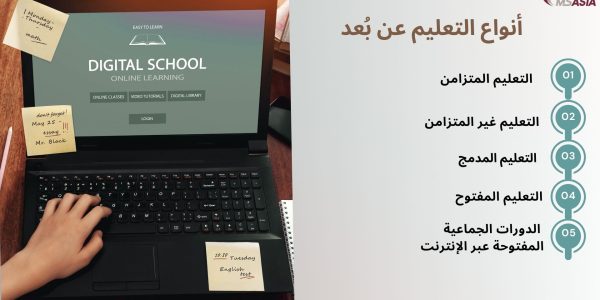
Types of distance education and related terms
1. Types of distance education:
A- Synchronized educationSynchronous Learning):
- Online interactive education, where the teacher and students are at the same time on platforms such as virtual classes or Zoom.
- Immediate interaction between students and teachers.
- Live lectures simulate the traditional chapter.
- For example: a live broadcast of lectures, webinars.
b- Asynchronous educationAsynchronous Learning):
- An education that does not require a synchronized presence, as the student can access the educational materials (recorded videos, PDF files, forums) at any time.
- High flexibility in time management.
- Fits with crowded streams.
- platforms like Coursera, Udemy.
C- Blended EducationBlended Learning):
- A combination of distance education and traditional, where the student participates in some attendance and some online.
- Combine the advantages of the two styles.
- Enhances direct interaction with flexibility.
D- Open EducationOpen Distance Learning – ODL):
- An educational system that does not impose age or qualification restrictions, and is provided on open platforms.
- platforms Edx, Khan Academy.
e- Open group courses onlinemoocs):
- Huge educational courses offered by international universities via electronic platforms, often free or at low cost.
- platforms FutureLearn, Coursera,MS Asia
2. Basic terms related to distance education:
| the term | The definition |
| e-learning (E-learning) | Using digital technology (internet and applications) to provide educational content. |
| Virtual Classes (Virtual Classroom) | An interactive online learning environment that simulates the traditional class with a teacher and students at the same time. |
| educational platforms (Learning Platforms) | Electronic systems through which the educational process is managed, such as moodle, Blackboard. |
| The gameplay (Gamification) | Use of game items (such as points and levels) to increase student interaction. |
| Adaptive Education (Adaptive Learning) | A system that controls the student’s level using AI to provide personal content. |
| mobile education (Mobile Learning) | Learning via mobile devices (phones, smart panels) anywhere. |
| Virtual Reality (VR) Augmented reality (en) | Technologies used to create 3D interactive learning environments. |
3. The difference between distance education and e-learning:
distance educationDistance Learning): A broader concept that includes any education that does not require actual attendance, be it online or postal correspondence.
- e-learninge-learning): Part of distance education, exclusively on digital means (videos, interactive tests).
challenges practices education About BُCounting For those with difficulties LearningُّM
The historical development of distance education
- Centuries 18-19: The Beginning of Correspondence Education (such as the Caleb Philips Declaration 1728).
- Early 20th Century: Radio and Television Use (Open University 1963).
- The 1980s-90s: Internet access and the establishment of online universities (University of Phoenix 1989).
- 2000 – Now: the spread of electronic platforms (such as MOOCs) and acceleration of dependence during the 2020 pandemic.
pdf The development Historical for education About BُCounting
pdf The development Historical for education About BُCounting
Technological development and its impact on distance education through the ages
Distance education has undergone drastic transformations thanks to technological development, as each stage of technology has played a role in making education more flexible, comprehensive and interactive. Here is a look at the most prominent stations and the impact of the Internet and digital technology:
1. Stage 1: Pre-Internet (20th Century)
● Correspondence Education: Reliance on sending study materials by mail, allowing learning without actual attendance, but it was slow and lacking in interaction.
● Television and radio: In the mid-twentieth century, radio and television channels were used to broadcast lessons (e.g., the University of the Open University in Britain). These means were expanding access, but one-way.
2. The revolution of computers and the Internet (the eighties and nineties)
● Personal computers and tablets CD-ROMIt enabled the provision of interactive materials such as educational programs, which promoted self-learning.
● The emergence of the Internet: With the network spread in the 1990s, email and forums began to be used to transfer content and discussions, reducing time and space barriers.
● learning management systemsLMS): Like Blackboard and Moodle, which organized the content and provided evaluation and progress tracking tools.
3. Web era 2.0 and digital technologies (2000–2010)
● Interactive and Multimedia: Tools like interactive videos and virtual simulations made learning more attractive.
● Social media platforms: contributed to creating educational communities through Facebook and Twitter.
● Virtual Class: Use programs like Skype to communicate directly between teachers and students.
4. Modern Revolution: Smartphones and Artificial Intelligence (2010-Now)
● Mobile Education: Applications like Khan Academy and Duolingo have made learning within reach at any time.
● artificial intelligenceAI):
○ Customize the educational experience by analyzing student data.
○ Use of educational robots (Chatbots) to answer questions.
○ Automatic evaluation of tests.
● data based educationbig data)Track students’ performance and improve curriculum based on analytics.
5. Future Technologies: Virtual and Augmented Reality (VR/AR)
● Virtual Reality: Simulation of educational environments (such as virtual coefficients or tours in museums).
● Augmented reality: adding digital layers to the real world (such as an explanation of the human body’s anatomy over the phone).
● Blockchain: documenting digital certificates and preventing forgery.
Major developments in distance education after 2020
1. Expansion and development of digital platforms
● Governments and educational institutions have become more dependent on integrated educational platforms such as the “Madrasi” platform in Saudi Arabia, which saw 92% of students and 97% of teachers, with more than 389,000 teachers trained to use it.
● In the UAE, interactive platforms such as “Alf” and “Matfek” have been added to improve the learning experience, with evaluation mechanisms updated to ensure the continuity of education.
2. Enhance digital infrastructure
● The pandemic has revealed gaps in digital infrastructure, especially in developing countries. In Jordan, studies have recommended that the Internet be provided to all regions to enable students to access distance education.
● However, regions such as Syria’s Idlib have faced great challenges due to frequent internet outages, which have affected students’ ability to complete exams or access educational content.
3. Improve teacher training
● Programs such as “Distance Learning Strategies” in the Caribbean focused on enhancing the digital skills of teachers, while providing supportive communities for the exchange of experiences.
● In Saudi Arabia, government and private efforts to train teachers to use interactive platforms have contributed to the success of Madrasati’s experience.
4. Digital Gap Challenges and Inequality
● The COFD-19 pandemic has led to a significant disruption in education and caused the loss of communication between many students and their teachers, and the gap between well-off and disadvantaged students has increased, especially with the dependence of education on resources such as the Internet and digital devices.
● In Europe and the United States, a few teachers use interactive tools such as video conference.
5. Transformation Towards Blended Education
● After the pandemic, many countries have begun to integrate digital tools with traditional education. For example, some schools in the UAE have developed plans to combine school attendance and distance education.
● In the Arab context, successful experiences have emerged, such as the American “Al-Nas” University, which helped Syrian students complete their education despite the difficult circumstances.
6. Long-term economic and social influences
● Countries like Germany and France have expected the economic losses of the pandemic trillions of the euro in the long term.
● In the Arab region, UNICEF has warned that a large number of Syrian refugee children are out of school, as the situation worsened due to the interruption of education during the pandemic.
.
Categories benefiting from distance education
1. Employees and Professionals: They seek to improve their skills or get qualifications without giving up their jobs.
2. Resident residents: they have difficulty accessing traditional educational institutions due to the geographical dimension.
3. People with Disabilities: Distance education provides flexibility and facilities to suit their own needs.
4. Parents: They need a flexible scheduling that allows them to balance the responsibilities of care and study.
5. Looking for rare specialties: distance education allows access to programs that may not be available locally.
6. Elderly and retirees: they want to complete their education or explore new areas after retirement.
7. People with unconventional tables: such as athletes, artists, or travelers frequently.
Distance education objectives:
1. Enhancing access to education: breaking geographical, economic and social barriers.
2. Time flexibility: enabling learners to study according to their personal and professional conditions.
3. Reduce costs: reduce housing, mobility and material resources.
4. Lifelong Learning Support: Encouraging individuals to continue personal and professional development at any age.
5. Benefit from technology: improving the quality of education through interactive tools and modern technologies such as artificial intelligence.
6. Ensure the continuity of education: especially in crises (such as pandemics or natural disasters).
7. Meeting individual needs: Providing personalized educational paths that suit different learning styles.
8. Professional development: providing continuous training courses for workers in various sectors.
9. Strengthening global cooperation: building educational networks between students and cross-border institutions.
Challenges and Disadvantages Facing Distance Education
1. Technical Challenges:
Weak technology infrastructure (expressed internet or suitable devices), digital gap (individual skills and capabilities), sudden technical malfunctions (disabled lectures or tests), and high dependence on electricity (especially in unstable currents). These barriers limit the opportunities for equitable access to education, especially in developing and fragile areas.
2. Social Challenges
● Social isolation: students lack direct interaction with colleagues and teachers, which affects motivation and personal development.
● Lack of organizational skills: students need high self-management to organize time and adhere to study without external pressure.
● Negative stereotype: Some employers or institutions question the credibility of certificates acquired through distance education compared to traditional education.
● Balance between life and work: the difficulty of separating the study environment and the home environment, especially with family or professional distractions.
3. Academic Challenges:
● Weak direct interaction: limited opportunities for bio-discussion or immediate feedback from teachers, which may affect the quality of understanding.
● The problems of fraud and lack of academic integrity: the difficulty of monitoring electronic tests and ensuring the credibility of the results.
● Deficiency of the applied side: the difficulty of providing practical training in specialties such as medicine, engineering or arts that require field practice.
● Digital Content: Over-reliance on electronic materials leads to visual and mental fatigue (technology stress).
● Software quality difference: the level of programs between organizations, with some undesigned professionals.
4. Psychological challenges:
● Loss of Enthusiasm: Decreased motivation for some students due to the absence of a competitive environment or direct moral support.
● Psychological stress: the feeling of tension as a result of trying to adapt to the new system, especially for those who lack technical experience.
5. Administrative and Legal Challenges:
● Difficulties of accreditation and recognition: Some programs have not been approved by official bodies in certain countries.
● Privacy and Security Issues: Risks of Personal Data Penetration or Privacy Infringement While Using Educational Platforms.
● Not suitable for everyone: it is not suitable for students who prefer sensory learning or direct interaction.
● Hidden Cost: Some programs may require the purchase of expensive software or tools.
● The decline in the quality of communication: the loss of body language and facial expressions that promote understanding in educational dialogues.
Realistic examples of successful distance education universities and platforms
Globally:
- Harvard UniversityHarvard University) and a platform Edx: They offer free courses and accredited certificates in a variety of fields.
- Massachusetts Institute of TechnologyMIT): A pioneer in providing open online courses and integrating advanced technologies.
- Open University in Britain (The Open University): One of the first leading universities in distance education, it offers flexible bachelor’s and master’s programs.
- University of Florida (University of Florida)): Offers online bachelor’s programs at low cost and academic support.
At the regional level (the Arab world):
- university Saudi Arabia electronic: It relies on integrated digital technologies in its approved programs.
- University Hamdan Coffee Muhammed smart (UAE): Focuses on business, quality and healthcare specialties through smart platforms.
- Edraak platform (Jordan): In partnership with EDX, it offers free courses with accredited certificates.
- Al-Imam Muhammad Bin Saud Islamic University (Saudi Arabia): Offers programs in Islamic studies and business administration online.
- Tunisian Virtual University (VUT): Offers courses in economics and applied sciences.
Prominent international and Arab educational platforms
- Coursera: It cooperates with international universities to offer a variety of specializations.
- Futurelearn: Provides courses from British and Australian universities.
- Platform Gallery (Saudi Arabia): It offers specialized courses in forensic and Islamic sciences.
- MS Asia: It provides a variety of educational services, language and training courses.
