
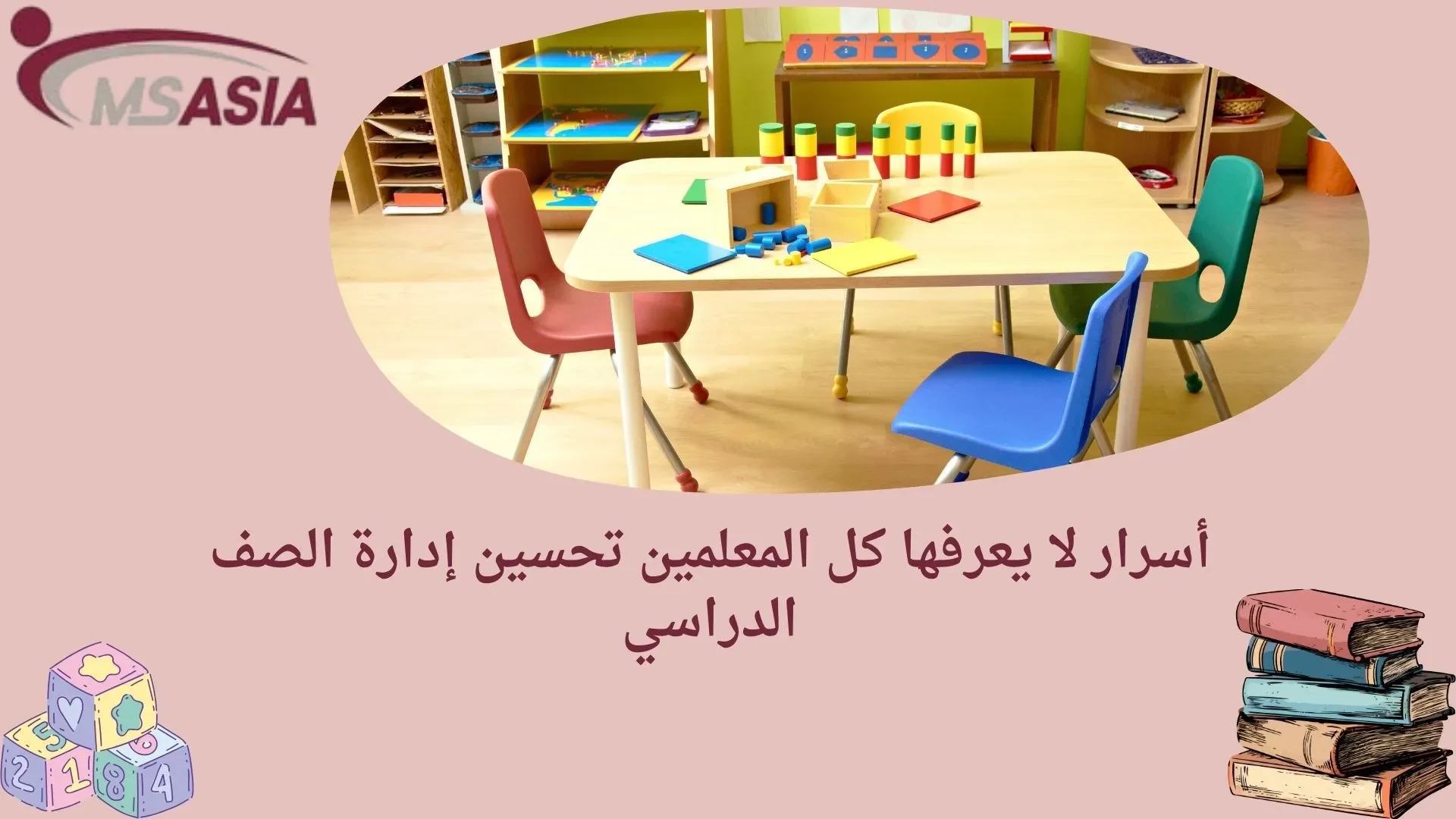
Class management is the successful educational process, as it constitutes the framework that regulates the interaction between the teacher and the students, and creates the optimal environment for achieving educational goals. Not only do you control behavior or impose discipline, it is an art of balance between providing an educational climate, building positive relationships, and using smart strategies to enhance active learning.
Successful classroom management is a combination of proactive planning and flexibility; The teacher plans his lessons carefully while preparing to adapt to emergency challenges, such as different learning speeds or unexpected behavioral situations. It also relies on a deep understanding of childhood psychology and differential education, to ensure that each student receives appropriate support for his learning style and circumstances, which contributes to the development of his academic, social and emotional skills in a holistic manner.
What is class management??
Classroom management is a plan that includes guidelines that help students understand, follow up and take responsibility for their behavior.
-
Create an organized and functional environment for the teacher and students
-
Create opportunities for academic learning and personal growth.
-
Reduce bad behavior in the classroom and other disorders.
-
Effectiveness in using time and always investing in learning.
-
Ensure that students are focused, motivated and produced.
-
Promote a comprehensive environment that meets all levels of competence of students
1. Establish clear and agreed class rules
Class rules are not just restrictions, but a collective agreement that transforms separation from chaos into an organized space that promotes learning. First: Design the grammar intelligently, by participating with students; Ask them to suggest what they see as necessary (such as: “How do we make our class a better place?”), and together choose 5-6 specific positive and specific rules, such as: “Quietly raise your hand to participate” rather than “Don’t Scream”. Second: Focus on practical application, define the rules from the first day with realistic examples, and set an example in adhering to them, and use positive reinforcement as praise of those who adhere to: “I like your respect for class time!” If there is a violation, calmly remind: “Remember our agreement on raising the hand?”, and if the behavior is repeated, discuss it with the student individually.
2- How to build positive relationships with your students?
Positive relationships with students first begin to know them as individuals; Each student called his name, and took care of his hobbies and questions as a first step towards breaking barriers. Then, listen more than you speak; Look at them when talking, and give them space to express without interruption, for good listening is the key to understanding their world.
Don’t stop there, but be human before you are a teacher; Share stories from your life, gently joke with them, and admit your mistakes humbly, because humanity melts the ice between you and them. When you face their mistakes, turn them into learning opportunities by saying, “This is a good attempt, but there’s a better way…”, rather than a reprimand that kills creativity.
From here, give them confidence; Ask them to lead activities, or solve simple problems, and encourage their initiatives, because trust develops a sense of responsibility. In parallel, be fair; Deal with everyone equally, and do not neglect the faint voice, for justice is the basis of mutual respect.
3- Use positive reinforcement to stimulate participation
Positive reinforcement is a powerful motivator to motivate participation, whether in class, work or even home. The idea is simply: link the participation with satisfactory prizes, such as a sincere praise, a symbolic material reward, or an open recognition of an individual’s contribution. For example, when you thank a student in front of his colleagues because he shared an unconventional idea, or you give an employee the opportunity to lead a project after his active initiative, you send a message that “Your participation is appreciated”, which prompts others to emulate.
The key is consistency and focus on voltage, even if the participation is simple. Avoid exaggerating financial rewards so as not to lose their value, and use instant reinforcement as a natural reaction to any positive reaction. Remember: sincere encouragement and recognition of others develop confidence and turn participation from a routine duty to an inspiring experience for all.
Quick example:
“Abdul Rahman, I noticed your diligence in organizing the team’s data, that will speed up the work a lot! Would you like to share your steps with us in the next meeting?” Here you combined the specific praise and the opportunity to participate, which enhances the continuity of Abdel Rahman And defended others.
4- Design interactive lessons based on practical activities
Designing interactive lessons is a fun challenge for teachers, especially when you rely on practical activities. Let’s start by setting the goal: first of all, you should ask yourself: What skill or concept do I want students to learn? For example, if the lesson is about “water cycle in nature”, your goal may be: to enable students to associate weather changes with scientific processes.
Then comes the stage of practical activity design. Here, choose an activity that transforms the abstract idea into something tangible. Let’s say you’re going to use a “Cloud in a bottle” experiment to explain the steam condensation. Then, divide the lesson into three stages:
Stage 1 (Explore): Start by asking an exciting question: “How are the clouds formed?” and watch a short video explaining the phenomenon.
Stage 2 (Application): Distribute the students in groups, and ask them to carry out the experiment using hot water, ice, and a transparent bottle.
The third stage (thinking): discuss the results with the students, and ask: “What have you noticed? How is this related to what is happening in the atmosphere?”
On the other hand, do not forget about the importance of evaluation. During the activity, watch the students’ interaction, and eventually, ask them to write a small summary of what they have learned. For example, you can use the “Concept Map” technique to link the steps of the experiment, the stages of the water cycle.
But beware of some common mistakes. First, avoid the complex activities that confuse students. Second, do not neglect the stage of thinking; It is an opportunity to establish learning. Finally, be sure to associate activity with everyday life, such as: “How does this experience help you understand the phenomenon of rain?”.
5- Student participation: the basis of a disciplined and disciplined classroom environment
Students participate in the cornerstone of building an organized and productive classroom. Without their interaction, the lesson becomes a monolithic dialogue that loses its energy, but when they are involved, the classroom environment turns into a living space in self-discipline.
For example, when part of the session is devoted to an open discussion on the subject of the lesson, and asks each student to express their opinion, here the students feel that their voices are heard, which reduces distracting behaviors. Moreover, you can use strategies like
Cooperative learning: dividing students into small groups to carry out a specific task, which enhances shared responsibility.
Positive reinforcement: praise the participants with specific words such as: “Your idea of solving the problem has added a new perspective!”.
On the other hand, you may face a challenge with shy students. To solve this, start with simple questions that do not need long answers, such as: “What do you think of this photo?”, and then be given to giving them small leadership roles, such as group activity coordination.
On the other hand, avoid the methods that make the student feel embarrassed, such as forcing him to answer everyone without his willingness. Instead, use “silent discussion” techniques, where students write their opinions on papers to hang on the wall, ensuring everyone’s participation without pressure.
6- Managing sabotage behavior in proactive methods
The subversive behavior management starts before the problem arises, not after. First, understand the roots of the behavior: is it boredom or a search for attention? For example, a student who interrupts the explanation by screaming may need a task that makes him feel important, such as helping you with the distribution of papers. Second, build a positive classroom environment with clear agreements, such as: “We’re talking about our role,” while promoting the commitment to words of encouragement: “Thank you for your commitment to calm during the explanation!” Also, plan proactive strategies: a secret signal between you and your students to remind them of calm, or a point system that rewards the entire class with fun activity if they stick. And don’t forget to turn negative energy into positive opportunities: a fidgety student who can lead a short kinetic exercise, and another who messes with his teammate who may be involved in the role of the teacher. Finally, avoid screeching or indiscriminate punishment; This increases the challenge. Remember: the disciplined chapter is not without errors, but the one in which mistakes are turned into lessons on which confidence is built.
comparison:
feature |
The traditional approach |
Self-assessment-based approaches and development |
The focus |
The reaction to the apparent behavior |
Understanding the causes and developing long-term strategies |
Understand the problem |
superficial, focusing on the student’s “mistake” |
Deep, he tries to understand the student’s motives, needs and context. |
The solutions |
Immediate penalties and threats |
Various strategies, positive enhancement, individual communication, teaching modification |
Student development |
Focuses on Virtual Compliance |
Aiming to develop the student’s skills and behavior in a sustainable manner |
The relationship of the teacher to the student |
It may deteriorate due to reprimand and fear |
It improves due to understanding, support and positive communication |
The teacher’s feeling |
frustration, fatigue, helplessness |
Greater control, effective, a sense of positive influence |
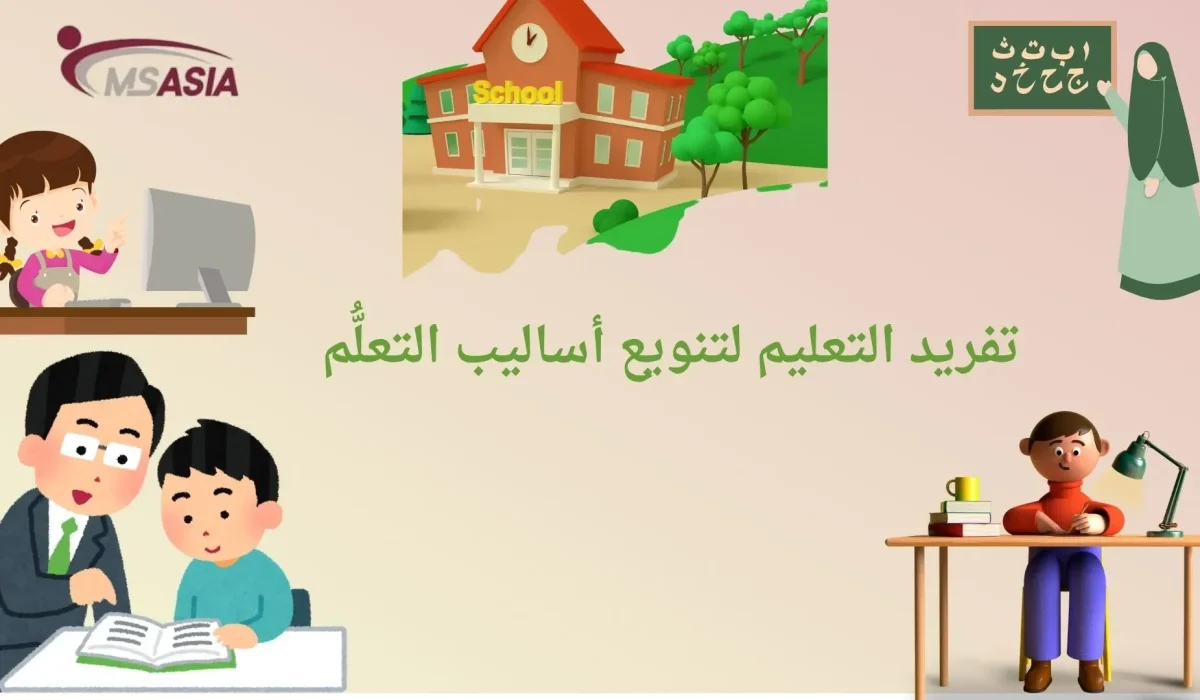
The concept of “individual education” refers to the design of customized learning experiences that meet the needs of each individual student, with an emphasis on diversifying methods and strategies to ensure that the educational process adapts to the individual differences between learners. This approach aims to enhance educational effectiveness and achieve educational justice, as diversification in learning styles is a key to enabling students to absorb knowledge according to their preferred methods and abilities.
The importance of individualizing education and diversifying methods
-
Response to individual differences:
Each student has a different visual, audio, kinetic, social, and unique learning style that ensures that these patterns are taken into account by providing diverse video content, interactive activities, group discussions, practical experiences.
-
Increased motivation and suspense:
Diversification breaks the routine and makes learning more attractive, especially with the integration of technology through games, virtual reality and smart applications.
-
Improving educational results:
When the content is presented in a manner consistent with the student’s abilities, his understanding and retention of information increases.
-
Empowering students with special needs:
Individuality facilitates the provision of tools and modifications to suit their needs, such as using text-to-speech tools for students with visual impairment.
Strategies for individualizing education and diversifying methods
Discriminatory education (Differentiated Instruction):
It is an educational strategy that fits the individual differences between students by dividing them into small groups based on:
Their academic level is beginners, mediators, advances
Their learning style is visual, auditory, and motor.
Their interests are attractive topics for them.
Practical example
First Group (Applicants): She is working on a research project on the applications of mathematics in everyday life, to promote analysis and creativity.
The second group (beginners): You receive a detailed explanation from the teacher with gradual exercises to ensure the basics are understood.
Project-based learning (Project-Based Learning):
It allows students to choose topics that interest them, which enhances independence and creativity.
continuous formative calendar:
Use short tests and daily notes to determine strengths and weaknesses, and to modify their methods.
adaptive technology (Adaptive Technology):
Smart platforms automatically adjust the difficulty of the content according to the student’s performance (such as math programs that increase challenges when you master the current level).
built-in learning (Blended Learning):
Integrating face-to-face learning with e-learning, giving students flexibility in choosing time and path

Technology facilitates instant communication and teamwork with a variety of tools. Groups can be created on WhatsApp or use Google Docs To participate in simultaneous editing of documents. In addition, platforms such as mss asia An integrated environment for student-teacher communication, file exchange, and discussion organization, which promotes effective collaboration within and outside the classroom.
Strengthening communication with parents
Effective communication with parents is an essential pillar for the success of the educational process, as tools such as classdojo Andpadlet And WhatsAppBuilding a permanent bridge between the school and the family. Through these platforms, teachers can share daily updates, such as student achievements, photos from classroom activities, or even behavioral notes. In addition, these tools allow parents to directly send their inquiries or comments, enhancing partnership and improving student support in and out of the classroom. Through regular and clear communication, the relationship turns into fruitful cooperation that contributes to achieving common educational goals.
Create a psychologically and socially safe classroom environment
The safe environment is built by instilling confidence and respect between students and the teacher, from encouraging open dialogue without fear of criticism, and the adoption of collaborative activities (such as group presentations or panel discussions) that promote empathy and acceptance. Setting clear and collectively agreed class rules contributes to reducing bullying, and promoting positive language and honoring differences makes students feel a sense of belonging. Merge tools like padlet To share feelings or classdojo To reward positive behavior supports building this environment, so that separation becomes a space for everyone to express freely and feel part of a supportive society.
Professional development is a vital pillar to keep pace with the developments of education, as workshops and exchange of experiences with colleagues enable the refinement of teaching skills and the introduction of innovative methods. Firstly, specialized seminars contribute to the understanding of the most recent educational theories, such as technology integration or the application of interactive learning. In addition, collaboration with other teachers helps through platforms such as Microsoft Teams In the exchange of successful experiences and overcoming common challenges. Furthermore, training on tools such as artificial intelligence or digital assessment of teachers allows for the quality and suitability of classes for students’ diverse needs. In conclusion, investing in professional development is not a choice, but a necessity to ensure a dynamic learning environment that inspires generations and achieves excellence.
Time management in the classroom is a crucial factor to achieve educational goals, without overburdening students or teachers. To begin with, it is recommended to divide the session into specific time intervals: short explanation (15-20 minutes), interactive activities (such as discussions or educational games), and then a quick evaluation (short tests or verbal notes). Moreover, using digital tools such as Google Calendar Or Trello Pre-planning lessons, prioritizing, and avoiding distractions. Also, it is preferable to allocate a “flexible” time to deal with the sudden questions or difficulties that arise during the explanation. In the end, good organization does not mean stagnation, but rather balances the structure and flexibility to ensure that every minute is used intelligently and effectively.

Flexibility is a vital skill for the teacher to face unexpected fluctuations in the classroom, such as technology disruption or students’ atmosphere. For example, when a presentation fails, you can quickly switch to an open discussion or alternative paper activity using tools like padlet. In addition, flexibility requires immediate assessment of students’ needs, such as modifying the lesson plan when it is difficult to understand a concept. Furthermore, adopting the “experience and learning” mindset helps transform challenges into creativity opportunities, such as integrating educational games when focus is low. Flexibility balance between commitment to plan and response to reality enhances a dynamic environment that maintains students’ interaction and achieves goals despite obstacles.
The difference between class management and row adjustment
class management (Classroom Management) |
tuning (Classroom Discipline) |
The target: Create an effective learning environment by organizing activities, interactions, and resources to achieve learning. |
The target: Maintain order and reduce negative behavior during the session. |
her nature: proactive Focus on preventing problems before they occur (such as: lesson planning, group division, and use of interactive tools such as padlet). |
her nature: reaction Problems are addressed after they appear (e.g. the rules of punishment when speaking without permission). |
tools: Includes planning, positive communication, student motivation, and diversification of strategies. |
tools: Sanctions include warnings, or conditional rewards systems (such as: classdojo). |
The field: More comprehensive and deeper, including everything that improves the educational experience (time, interaction, evaluation). |
The field: Narrower, it is limited to dealing with wrong behaviors. |
The result: Building a trusted relationship between the teacher and the students, and motivating them to participate. |
The result: Achieving a temporary system that may not enhance self-motivation. |
Noticeable
-
Management = building a successful educational system
-
Setting = Fixing a bug in the system
-
Effective management reduces the need for control
