
التعليم التعاوني تفاعل الثقافات وتوظيف التكنولوجيا لبناء نموذج تعليمي متكامل
Cooperative education is an educational approach that transforms focus from memorization to students’ interaction in small groups to achieve common knowledge exchange goals. It relies on principles such as collective responsibility and effective communication, as each individual contributes according to his abilities and benefits from his colleagues. It develops problem-solving skills, critical thinking, and teamwork, which are suitable for the requirements of the modern labor market. Encourages active learning through student participation in knowledge-building, and promotes values such as empathy and respect for others, creating a comprehensive and balanced learning environment.
Cooperative education promotes teamwork and individual responsibility, taking advantage of its cultural diversity to create an interactive environment that develops language and social skills. Institutions such as Kuala Lumpur University and my digital college depend on collaborative activities such as international research projects and small groups. Despite challenges such as lack of resources, Malaysia adopts supportive policies for increasing budgeting and training teachers through programs such as MS Asia, building innovative education that is capable of global competition. Subscriber.
Positive solidarity is based on the success of the group’s success with the success of the group, individual accountability and each individual’s responsibility for his participation, and direct communication is a face-to-face interaction to exchange ideas. It is complemented by the development of social skills such as listening and conflict resolution, constantly evaluating the group’s performance, and mutual reinforcement of building confidence that produces an effective education that prepares a world based on teamwork. In addition, cooperation between students of different backgrounds enhances the respect for cultural diversity, and prepares them for team-based work environments, where cooperation is an essential feature. to succeed. Teaching the Arabic language specifically has a lot of benefits from the application of the principles of cooperative education, which are as follows:
-
Improve language proficiency: Continuous interaction enhances fluency and accuracy in using grammar.
-
Strengthening social skills: teamwork develops the ability to dialogue and respect different opinions.
-
Reducing individual differences: heterogeneous groups allow outstanding students to help others, balancing class levels.”
How does the teacher’s role in cooperative education differ from traditional education?
The cooperative education is based on clear foundations that make a shift in the classroom dynamics. This transformation is particularly evident when the teacher’s role in this approach is compared to the traditional teaching:
The side |
traditional education |
cooperative education |
|
|
|
|
source of knowledge |
The teacher is the only main source of knowledge. |
Knowledge is built jointly through student interaction. |
Teaching method |
Recitation, lecture and indoctrination. |
Interactive activities, discussions and teamwork. |
Student’s role |
Mostly negative listener, receives and saves information. |
An active participant who collaborates, shares ideas and solves problems. |
teacher’s role |
Instructor, row-dominant, focuses on information transfer. |
Facilitator, guide, organizer, focuses on supporting student learning. |
interaction |
Limited among students, focus on the teacher’s interaction with the student. |
Great interaction between students, peer learning. |
evaluation |
It often focuses on individual tests and final results. |
Includes teamwork evaluation and individual and practical participation. |
class management |
Depends on the individual teacher control. |
Depends on the responsibility of the students’ shared and teamwork. |
The focus |
on content and information. |
On the educational process and skills development. |
Mind Maps: The Secret of Information Organizing and Promoting Understanding
Mind maps are an innovative visual tool that transforms complex information into an organized and visual structure, making it easier to understand and remember. It relies on linking the main ideas to sub-branches using keywords, colors, and symbols, which simulates the way the integration works in the linking of concepts.
Promote learning. Through the theory of social interdependence (Johnson and Johnson), the success of the individual becomes linked to the success of the group, as tasks are designed to enhance cooperation through common responsibility and avoid negative competition that weakens collective ties. Social cognitive theory (Pandora), which emphasizes that learning occurs by observing a successful model (such as peers or teacher), which raises self-confidence and motivates students to imitate effective methods. While constructivist theory (Piagee and Vyjutsky) adds a deep dimension, knowledge is not acquired, but rather built through experiments and dialogues, especially when students interact with more efficient peers (approximate growth zone) or face. Different opinions create a conflict of knowledge that reshape concepts.
Not only that, according to the theory of social exchange, individuals cooperate when collective gains (such as appreciation or grades) cooperate with their joint efforts, while effective communication theory focuses on the necessity of social skills. (such as listening and feedback) to ensure fruitful interaction within groups.
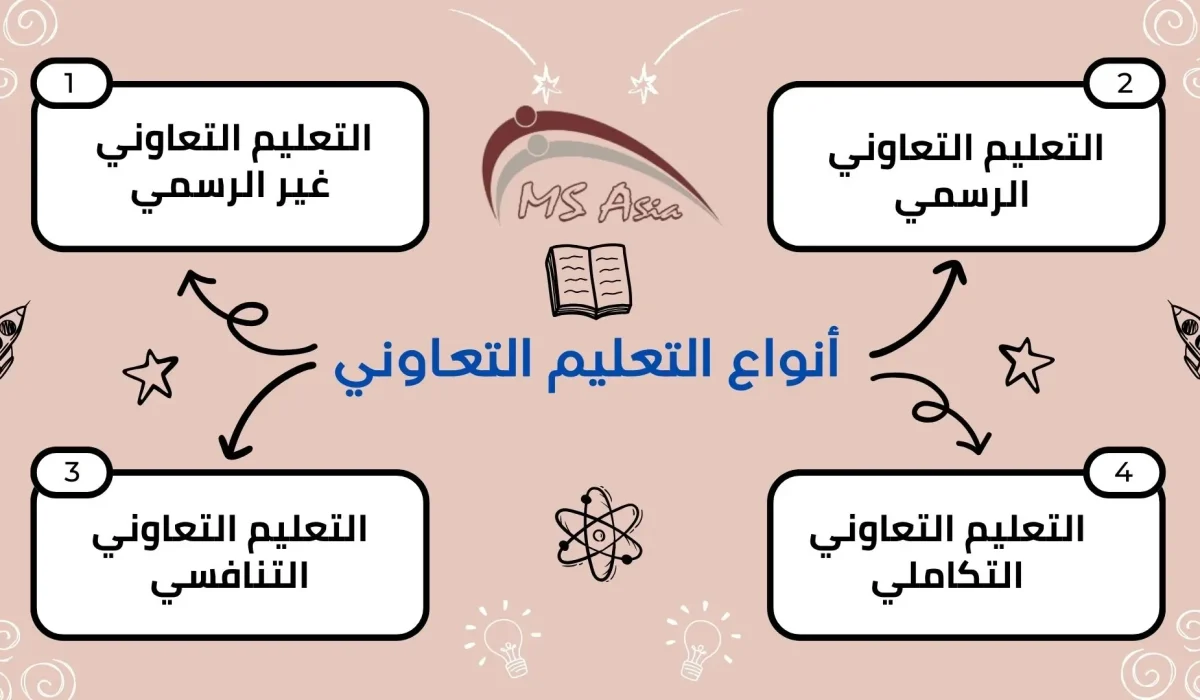
Types of cooperative education
Cooperative education is classified into several types based on the nature of interaction, purpose and structure. Here are the main types:
1. Formal cooperative education (Formal Cooperative Learning)
■ A time-specific structured structure that often lasts for several sessions or weeks.
■ It is used to achieve specific educational objectives (such as solving a complex problem or project completion). Divide the students into small groups with clear roles (leader, writer, notes…etc).
● The existence of collective and individual assessment criteria.
2. Informal cooperative educationInformal Cooperative Learning)
○ Short term interaction (minutes to one class) without permanent division of groups.
○ It is used to enhance instant understanding or stimulate thinking during the explanation.
○ High flexibility, focuses on quick discussion or simple workout solution.
○ It does not require specific roles or detailed evaluation.
3. Integrative Cooperative Education (Cooperative Integrated Learning)
○ Integrating cooperative education with other educational strategies (such as project-based learning or blended learning).
○ It aims to deepen understanding by linking knowledge to practical skills.
○ Combine teamwork, self-learning or technology.
○ It focuses on integration between disciplines (such as: science + arts + language).
4. Competitive Cooperative Education (Competitive Cooperative Learning)
○ Mixing collaboration within the group with competition between groups.
○ It is used to increase enthusiasm and stimulate productivity.
○ Enhances internal teamwork with external stimulation (prizes or points,).
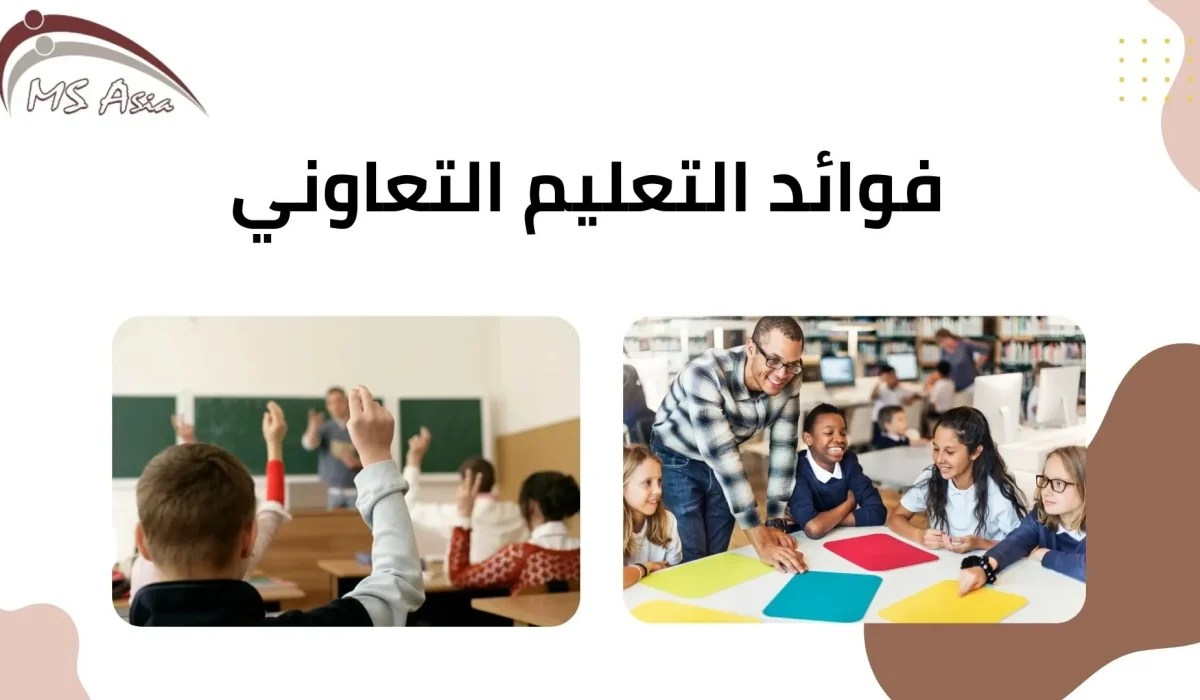
Cooperative education improves academic achievement by collectively exchanging knowledge and clarifying concepts, which deepens understanding and proves information. At the same time, he develops skills such as teamwork, leadership and communication, transforming the classroom into a working life training workshop. Students also feel a sense of belonging and reduce their sense of isolation, which raises their motivation to learn. In addition, cooperation between students of different backgrounds enhances respect for cultural diversity, and prepares them for team-based work environments, where cooperation is a feature. essential to success.
Cooperative Education Applications
They vary greatly and include strategies and tools that can be used in various educational levels and subjects. The main objective of these applications is to enhance students’ interaction with each other, develop their social and communication skills, and improve their understanding of the subject through joint work. Here are some general applications of cooperative education:
Cooperative Education Strategies and Tools:
-
Task Teams: Students are divided into small groups (usually between 2 to 6 individuals) to work on a specific task or project. Roles are distributed within the group to ensure that everyone contributes and achieves positive mutual dependence.
-
Joint Assessment: This can include students’ assessment of each other’s work based on specific criteria, or calculating the group’s degree based on the performance of individuals. This motivates students to help each other improve team performance.
-
Different groups: Form groups of students of different levels and abilities. This allows the applicants to help their colleagues who need support, while everyone benefits from the diverse views.
-
Intersecting Parts Technology (Jigsaw): The subject is divided into parts, and each member of the group specializes in a specific part. Then students who specialize in the same part of the various groups gather to discuss it, before returning to their original groups to teach their colleagues what they have learned.
-
Think – Marry – Share (think-pair-share): A question or problem is asked, and students are given time to think about it individually, then discuss it with a colleague, and finally share their thoughts with the entire class.
-
Collective brainstorming: encourage students to present as many ideas as possible on a particular topic in a non-critical atmosphere, and then these ideas are compiled and discussed.
-
Case study: Analyze and discuss realistic scenarios collectively to apply theoretical concepts and develop problem-solving and decision-making skills.
-
Acting and role-playing: using acting scenarios and situations to understand different points of view and develop communication and empathy skills.
-
Digital platforms and tools: the use of web applications and collaborative software online to support teamwork, resource sharing, and remote communication.
Examples of cooperative education applications in different subjects:
-
Science: conducting experiments in groups, analyzing data and sharing results, designing joint research projects.
-
Mathematics: solving complex problems together, explaining concepts to colleagues, reviewing tests collectively to identify and understand errors.
-
Languages: practicing conversation in pairs or small groups, writing shared stories or articles, oral group oral presentations.
-
Social Studies and History: Analysis of historical sources together, preparing presentations on historical events or personalities, discussing social issues from different points of view.
-
Arts: Teamwork in creating artworks, performing joint musical or theatrical performances, evaluating the work of colleagues and providing feedback.
Effective teacher preparation begins with the promotion of mental and cognitive aspects, by mastering scientific content and modern curricula, and participating in continuous training courses to learn interactive teaching strategies such as educational technology, with the development of flexible planning and classroom management skills.
It is not limited to technical skills, but the inner motivation of the teacher and his real desire for education, which appear through his creative initiatives and participation in school activities, is required, in addition to linking his goals with the goals of the educational institution.
It also focuses on the psychological and social aspect, by training teachers on stress management and building positive relationships with students through effective communication, emphasizing justice in evaluation and avoiding bias.
It is necessary to develop formative skills such as using voice and body language effectively, and to diversify educational methods such as integrating games or creativity in the explanation to avoid monotony.
This process is supported by academic preparation programs that combine theory and practice (such as field training), and continuous workshops on modern challenges such as artificial intelligence and international exchange programs.
Teachers are empowered to give them decision-making powers and train them on modern technological tools, such as digital platforms and data analysis, with the design of educational plans that suit cultural diversity.
What is distance learning?
An educational system based on providing academic content via digital platforms (virtual chapters, recorded videos, interactive platforms) without the need for an actual presence in a specific place. It spread strongly with the development of technology
What is the educational technology revolution? and the best digital tools to support teachers
The educational technology revolution refers to the use of technology to enhance teaching and learning experiences in education. It includes developments in technology that have changed traditional teaching methods, making education easier and more flexible for students around the world. mother–s–Asia Significant developments in education. Learning management systems, digital textbooks, online courses, educational applications, virtual reality and artificial intelligence tools are common educational technology tools that have transformed education. For example, online learning platforms made it possible for anyone to learn from anywhere and at any time. This has made education easier, flexible and convenient for learners who cannot attend traditional classrooms.
Among these tools, Google Classroom AndZoom, which contribute to direct communication between teachers and students and facilitate the exchange of study materials. These tools give teachers the ability to create virtual classes, organize classes, and provide interactive learning content, which makes distance learning experience very close to traditional education.
pdf About Effect Role technology In a Improvement Quality education
Artificial Intelligence in Education
Artificial Intelligence (AI) revolutionizes education by providing custom learning experiences that suit each student’s needs, abilities and learning style. Smart platforms, such as Adaptive Teaching Systems and Chat Robots, are based on real-time data analysis to provide dynamic educational content, with instant feedback and targeted support. For example, if a student has difficulty in a concept, the system automatically adjusts the difficulty level or suggests additional resources to fill the gaps.
According to recent studiesInstitution Walton2024Artificial intelligence has become an essential part of the classroom, as it uses it. 50% Teachers, students and parents, especially in subjects such as English and social studies. It also contributes to simplifying teachers’ management tasks, such as creating educational materials or evaluating assignments, allowing them to focus on human interaction.
However, schools face challenges such as lack of policies and lack of adequate teacher training, especially in urban areas. Students and parents are also concerned that schools will not prepare them for a future based on artificial intelligence.
To enable effectively this technology, schools need:
-
Develop clear policies to integrate AI into the curriculum.
-
Training teachers to use smart tools effectively.
-
Educating students about the ethics and potential of AI.
Search About Design Environment educational Virtual Depeneds To Technics intelligence artificial to support students teachers In a Acquisition skills The design educational Read more
Teaching Arabic to non-native speakers
Teaching Arabic faces challenges such as the complexity of grammar (grammar and morphology) and the duality between classical and colloquial, which confuses learners. In addition to the difficulty of writing, the different shapes of the letters and the dialectical differences that impede the auditory understanding. For the solution, it is recommended to integrate classical with dialects through audio-visual materials, and to use technology interactive applications to simplify writing and grammar. Practical skills should also be enhanced through contextual training, role-playing, daily tasks, and language linking with culture, like and habits.
the difference Between Finding Learn The language Arabic Between pupils Grade demo (education the cooperative) and class officer (education traditional).
Utilization Applications phones smart In a Education The language Arabic for the speakers in languages New In a Institute Education The language Arabic for others sniffer with it At the university Islamic
How does Steam make a creative generation?
-
Integrating majors:
Integrating science, technology, engineering, arts and mathematics into one project (such as designing an art robot or building a sustainable city model) that teaches students to see problems from multiple angles and find innovative solutions.
-
Practical Learning:
Converting classes into applied workshops (such as making simple hardware or interactive games programming) develops curiosity and the ability to experiment and learn from failure.
-
Arts drive creativity:
The introduction of arts (drawing, music, design) into technical projects stimulates imagination and transforms abstract ideas into tangible and attractive products.
-
future skills:
Develop critical thinking, teamwork, and complex problem solving through Steam Challenges prepares students for jobs that have not yet been invented!
-
Connecting learning to life:
Projects such as environmental data analysis or design solutions for traffic congestion show students the impact of their creativity on the real world.
Design of teaching aids
First of all, the design of effective teaching aids begins with a deep understanding of the educational objective and the needs of the students, by analyzing the difficulties they face in the classroom. The means are then built on the basis of simplicity and clarity, taking into account the individual differences by integrating various (visual, interactive, digital) patterns. Don’t neglect the role of modern technology such as virtual reality or artificial intelligence, but remember that simple manual means may be the most effective!
Go to the practical development stage by designing a prototype using simple tools like Canva or educational games via ScratchAnd tested it with a small group of students to collect feedback. Avoid common mistakes, such as focusing on form, without content, or neglecting students’ participation in the design. Finally, rely on flexibility; Education is a dynamic process that requires constantly modernizing the means to keep pace with the changing needs of the learners and the development of the curriculum.
(The key: designing successful teaching aids = student understanding + creativity in implementation + continuous evaluation).
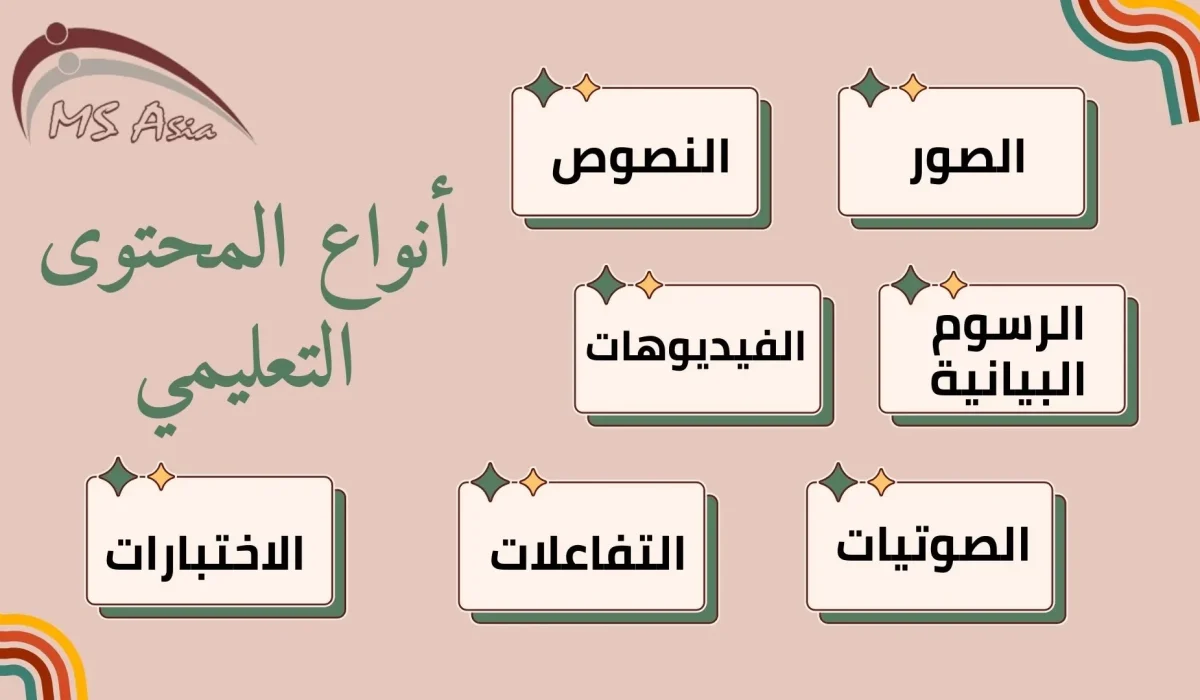
Texts: Texts are used to provide information and explain concepts.
Images: Images are used to illustrate the concepts and make the content more attractive.
Graphics: Graphs are used to visually display data.
Videos: Videos are used to display information in a more lively and attractive way.
Acoustics: The phonetics are used to provide information to learners with reading difficulties.
Interactions: Interactions are used to encourage learners to participate in the learning experience.
Tests: Tests are used to assess learners’ understanding of content.
Leading initiatives and experiences in smart and collaborative education
1. The experience of the University of Malaya in Malaysia:
Malaya University is considered one of the pioneers in adopting participatory education models and distance education.
-
Various study programs:
Integrates between attendance and open learning (ODL), with an emphasis on innovation and critical thinking, which qualifies students for the global labor market.
-
College of Education:
International conferences such as the First International Education Conference (IEC) are organized on innovation in education, and workshops on the use of technology in teaching, such as the “E-Learning for Beginners” workshop.
-
Student exchange programs:
Provides opportunities for international students to join a variety of classrooms, with tuition fee waiver, promoting cultural interaction and exchange of experiences.
2. Smart School Initiative:
The smart school is an educational model based on technology integration to improve the quality of education, such as the use of e-learning platforms, and smart applications to manage school operations (such as recording absences, follow-up behavior, and communication with parents). Examples include:
-
The “Smart School” application in Saudi Arabia and Kuwait:
It enables teachers to register absenteeism and send student behavior notes, and enables parents to immediately follow their children’s performance through customized applications.
-
Saudi Digital School System:
Provides comprehensive solutions for personnel and student management, such as vacation follow-up, test preparation, and electronic certificates, while ensuring data security via a certificate. ISO 27001 .
These initiatives face challenges such as the high cost of technological infrastructure, and the digital divide between students. But the solutions include:
-
Teacher training to use modern tools (such as MS Asia in Malaysia)
-
Provide safe cloud storage systems
3.Mohammed Bin Rashid Intelligent Initiative (2012):
-
Provides all schools with high-speed Internet networks (4th generation) and tablets for students.
-
Creating interactive smart classes that promote participatory learning through platforms such as the Distance Learning System
Concrete results:
-
The number of patents in universities increased to 1000 in 2020.
-
The UAE is ranked first in the Arab world in mathematics and science tests
Successful case studies between universities in Malaysia and China
The academic collaborations between Malaysia and China are a model for exchanging experiences, although they are often focused on Chinese, but they provide a framework that can be applied to Arabic:
-
Xiamen University of Malaysiaxmum)China has created it as part of its “soft power” strategy through education. It focuses on Chinese language teaching and the establishment of Confucius Institutes, but its methodology for integrating culture with language (such as designing an artificial lake similar to the Chinese campus) can be reproduced to teach Arabic.
-
The Center for Chinese-Malaysian Relations Studies at Jinan University: Promotes joint research in cultural fields, a model that can be applied to Arabic-Chinese influence studies.
