
Cooperative learning groups are an essential pillar in modern education, as they are grouping students into small groups to achieve common educational goals. Through strategies such as marital thinking and participation, riddles, and project learning, direct interaction, positive mutual dependence, and individual responsibility among students are enhanced. These groups not only contribute to deepening academic understanding, but also develop the skills of the twenty-first century, such as communication, critical thinking, and problem solving. In this article, we will review the most prominent models of cooperative learning groups, their applications in various educational contexts such as Steam, and how to integrate technology to enhance their effectiveness. The role of the SM Asia platform.
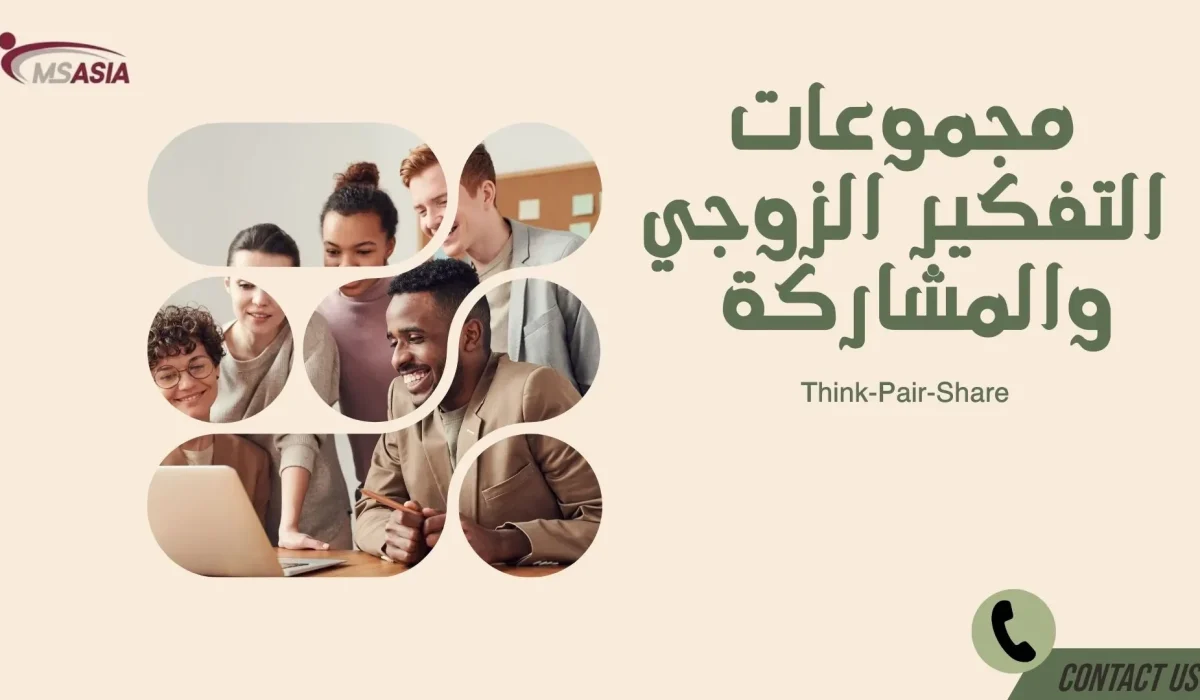
Marital Thinking and Sharing Groups (Think-pair-Share):
Think-pair-share is one of the most effective and simple cooperative learning models, allowing students the opportunity to think individually, discuss ideas with a colleague, and then share them with the big group. This strategy relies on promoting direct interaction and individual responsibility, which contributes to building a supportive and stimulating learning environment. By integrating critical thinking and effective communication, this method enables students to deeply understand concepts and develop the skills of the twenty-first century.
Think-pair-share Strategy Steps
Steps:
-
thinking (THINK)A question or problem arises (such as “How can solar efficiency be improved?”). Each student thinks individually and records his thoughts.
-
marital (Pair)Students discuss in pairs, exchange ideas and express their views.
-
Post (Share)The husband or one of his members shares ideas with the grand group or class, allowing for wider discussion.
Benefits:
-
All students are encouraged to participate, even shy ones, because the initial discussion takes place in a safe (marital) environment.
-
Promotes positive mutual dependence through the exchange of ideas.
-
Fits different age levels and study materials.
Application of marital thinking groups and participation in context Steam:
Example: In a lesson on robots, the question arises: “What are the challenges in the design of an oceanic robot?”
Think: Students write their thoughts about challenges (such as water resistance or waste collection).
Marriage: Students discuss solutions such as the use of corrosion-resistant materials.
Participation: Each pair offers an idea for the class, and ideas may be integrated into a group design.
A collaborative board in MS Asia can be used to record thoughts in the thought stage, and then share the marital discussion summary in a dedicated section.
Technology integration:
If you are using MS Asia, students can enter their ideas into digital forms or forums, and then conduct a couple discussion through small chat rooms. After that, ideas can be displayed on a central cooperative panel.
Tools like padlet can also be used to visually record ideas in the “share” stage.
Recommendations for teachers
For teachers, they formulate open questions related to the Gulf context, such as “How Solar Energy Improves the Sustainability of Smart Cities?”, to stimulate thinking. At the thought stage, encouraged writing ideas on cards to support shy students. During marriage, distribute the couples to integrate skills, while observing discussions to ensure interaction. In the participation, they used checklists to evaluate contributions, and link ideas with initiatives such as Vision 2030 to strengthen the link to the curriculum.
Possible challenges and solutions
-
Incompatibility of spouses:
-
Challenge: Disparity of students’ levels affects the discussion.
-
Solution: Choosing pairs with complementary skills or random distribution.
-
-
Limited time:
-
Challenge: the stages took a long time.
-
The solution: to set a time (3 minutes to think, 5 for marriage) with a timer.
-
-
Limited post:
-
Challenge: the shy students’ hesitation.
-
Solution: Use anonymous cards to write down ideas
-
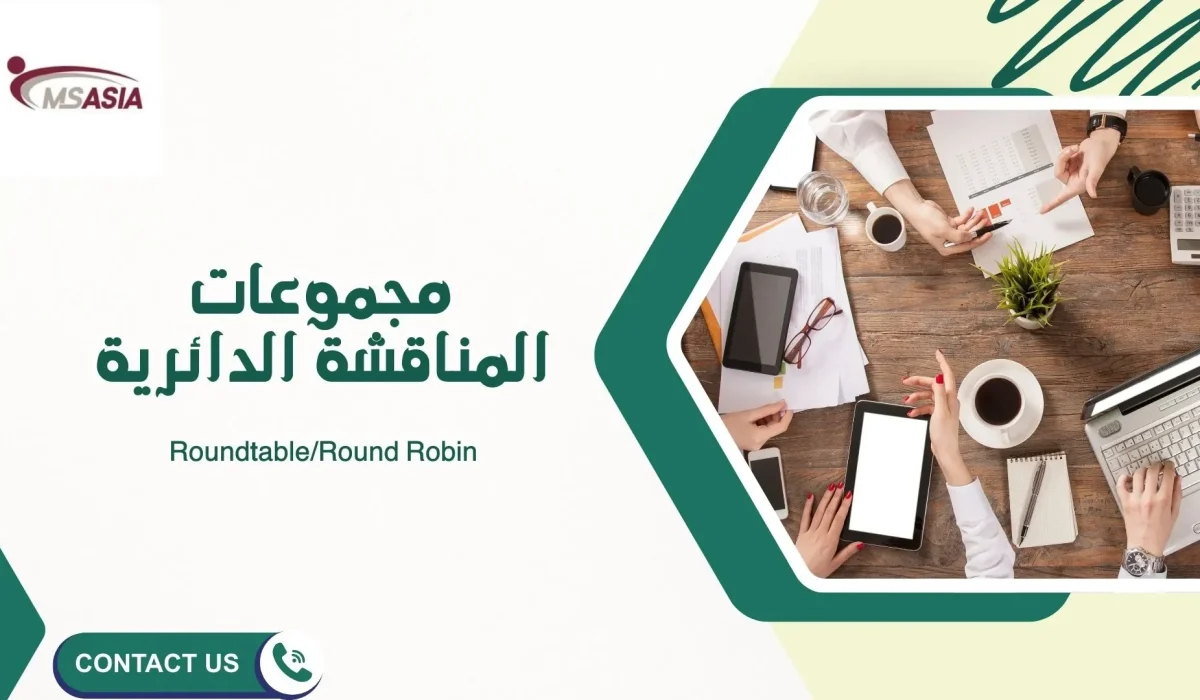
2. Roundtable/Round Robin:
It is a prominent model of cooperative learning aimed at ensuring the participation of all students through an organized rotation of contributions. In this strategy, the group members take turns providing ideas or answers, whether written or oral, on a specific topic, which enhances direct interaction and equality in participation. This method contributes to building a supportive learning environment that encourages creativity and individual responsibility, while promoting positive mutual dependence among students.
Roundtable/Round Robin Strategy Steps
-
Setup: A question or topic is asked (such as “What are the innovative solutions to reduce plastic waste?”). Students are divided into small groups, and each student is provided with a contribution recording tool (paper, digital plate, etc.).
-
Rotation: Each student, in turn, contributes an idea or an answer, either by writing (such as adding an idea to a common paper) or verbally (such as speaking in a role). The alternation continues until a sufficient number of ideas are collected.
-
Sharing and Discussion: Ideas are collected and discussed within the group or presented to the entire chapter, giving an opportunity to evaluate or develop ideas.
Recommendations for teachers for circular discussion groups
Create open-ended questions that stimulate creativity, such as “What’s to reduce plastic waste?” To encourage thinking. In the setting, distribute the groups to include various skills, and present common papers to record ideas. During the rotation, set a time (30 seconds per student) to ensure equal participation. In the discussion, they encouraged the evaluation of ideas based on their feasibility, and used checklists to evaluate individual contributions to link activities to the curriculum.
The benefits
-
Comprehensive participation: the circular system ensures that each student contributes, reducing the dominance of the most daring individuals.
-
Enhance creativity: encourages the generation of various ideas in a short time.
-
Flexibility: Fits different subjects and ages, from simple discussions to solving complex problems.
The application of circular discussion groups in context Steam
-
Example: In a lesson on designing a sustainable city, the question arises: “What features should be included in an environmentally friendly city?”
-
Setting: Students are divided into groups of 4-5 people, and each student is given a role in the rotation.
-
Rotation: Each student proposes an idea (such as electrical transmission systems, vertical gardens) and adds it to a collaborative board.
-
Participation: The group presents a list of their ideas for the class, discussing how to integrate these features.
-
3. Jigsaw Puzzles Kits
Jigsaw is one of the most creative and influential cooperative learning strategies, designed to enhance positive mutual dependence and individual responsibility by dividing the educational process into interconnected parts. In this strategy, the students are divided into “main” and “expert” groups, where each student specializes in a specific part of the subject in the expert group, and then returns to teach his colleagues in the main group. This process is like grouping puzzles to form an integrated learning image, making students active partners in the learning process.
Jigsaw Puzzle Strategy Steps
-
Divide into main groups (Home Groups): Students are divided into small groups (4-6 individuals), where each main group is responsible for covering a comprehensive topic (such as “renewable energy sources”).
-
Expert Groups Formation: Each student from the main group is appointed to study a specific part of the subject (such as solar, wind, or hydropower) within a dedicated group of experts.
-
Learning in Expert Groups: Students go deep into studying their subject by reading, researching, or discussing, and preparing content to teach their colleagues.
-
Back to the main groups: the students return to their main groups, where each “expert” takes turns educating his colleagues about his part, which complements the comprehensive understanding of the subject.
-
Evaluation and Discussion: Group discussion or evaluation activity (such as a short test or presentation) is held to ensure that everyone understands the material.
The benefits
-
Strengthening individual responsibility: each student is responsible for learning and teaching a specific part, making it an essential element in the success of the group.
-
Positive Mutual Reliance: Students rely on each other to understand the whole subject.
-
Develop communication skills: Explaining concepts clearly requires effective presentation and teaching skills.
-
Suitable for complex themes: Ideal for covering multifaceted themes like Steam.
Application of puzzle groups in context Steam
-
Example: In a lesson on the design of a sustainable ecosystem, the subject is divided into parts (such as water management, renewable energy, recycling).
-
Partition: Each student is appointed in the main group to study a part (e.g. water management).
-
Expert Groups: Students learn about their subject (such as water purification techniques) using resources or research.
-
Education: Students return to educating their colleagues, which is a comprehensive understanding of the ecosystem.
-
Final Activity: Designing an ecosystem miniature model based on the knowledge gained.
-
cooperative board template for puzzle groups
If you want a collaborative board template, it can be designed as follows (brief example):
-
Section 1: Expert Groups Resources (Space per Subject Subject to load material).
-
Section 2: Expert summaries (each student records his summary after study).
-
Section 3: Offers in the main groups (a space to score the main points that have been taught).
-
Section 4: Assessment (questions or comments to assess student understanding).
-
Teamwork Groups (Team-Pair-Solo):
4. Team-Pair-Solo Groups:
Team-pair-solo group work is an innovative collaborative learning strategy aimed at promoting gradual learning through the transition from teamwork to individual and then individual work. In this strategy, students start collaborating with a team to solve a problem or complete a task, then work in pairs to develop their skills, and finally face the challenge individually, which enhances self-confidence and independence. This method focuses on building positive interdependence in the early stages, while strengthening individual responsibility in the final stage. In this article, we will review the mechanisms of implementing Team-Pair-Solo strategy, its benefits in educational contexts such as Steam, and how to integrate technology, such as the MS Asia platform, to enhance its effectiveness.
Teamwork Strategy Steps
-
Teamwork: Students are divided into small teams (4-6 individuals) to cooperatively address a complex problem or task (such as designing a model of a strong bridge using limited materials). The team shares ideas, distributes tasks, and develops a common solution.
-
Couples: The team is divided into pairs, where each pair focuses on improving part of the solution or applying it deeper (such as simulation bridge stabilization testing). The couple exchange ideas and give notes to each other.
-
Individual work (SOLO): Each student applies what he has learned independently, such as designing a miniature version of the bridge or solving a similar problem alone. This stage shows how well the student understands the concepts.
The benefits
-
Gradual Learning: Allows students to move from collective support to independence, which enhances self-confidence.
-
Strengthening social and individual skills: combines cooperation (in team and spouse) and individual responsibility (in the individual stage).
-
Suitable for complex tasks: ideal for projects that require multiple stages, such as designing engineering solutions in Steam.
-
Flexibility of application: it can be used in various material and age levels.
The application of teamwork groups in the context of Steam
-
Example: In a lesson on designing a waste collection robot, the strategy can be applied as follows:
-
Team: The team works together to design the robot, identifying components (such as motors, sensors) and role distribution (such as the researcher, the designer).
-
Husband: Each pair focuses on a specific part, such as sensor programming or mechanical arm design, with solutions testing.
-
Individual: Each student designs a miniature model or writes a report on his role in the project.
-
6. Brainstorming Groups
Brainstorming Groups is a dynamic collaborative learning strategy aimed at stimulating creativity and generating a variety of ideas on a particular topic in a direct criticism-free environment. Students gather in small groups (3-5 people) to propose freely thoughts, which promote direct interaction and encourage everyone to contribute without fear of evaluation. This strategy focuses on promoting positive mutual dependence by building ideas on each other, making it a powerful tool to stimulate innovative thinking in educational contexts such as Steam.
Brainstorming Strategy Steps
-
Setup: A question or an open problem arises (such as “How can an art gallery be designed that reflects the Gulf heritage?”). The teacher explains the rules of brainstorming: not to criticize, to encourage unconventional ideas, and to build on the ideas of others. A coordinator is assigned to each group to ensure everyone’s participation.
-
Idea Generation: Students propose their ideas freely, either verbally or by writing them on a common board (paper or digital such as MS Asia interactive). A time (5-10 minutes) is set to generate as many ideas as possible.
-
Categorization and Discussion: The group reviews ideas, classifies them by priority or feasibility (such as cost or creativity), and discusses how they are developed.
-
Participation: Each group presents its selected ideas for the chapter, with the possibility of a prototype or an illustration.
The benefits
-
Creativity Stimulation: Lets students think freely without fear of judgment, producing innovative ideas.
-
Comprehensive participation: encourages even shy students to contribute to a supportive environment.
-
Promoting group thinking: relies on building ideas cooperatively, which promotes mutual dependence.
-
Flexibility of application: suitable for various study materials, from arts to mathematics, in Steam contexts.
Application of brainstorming groups in context Steam
Example 1: Arts
In the arts-focused Steam lesson, the question arises: “How can an art gallery be designed that reflects the Gulf heritage?”
-
Preparation: Students are divided into groups, and provided with a cooperative plate in MS Asia.
-
Idea Generation: Students propose ideas such as creating paintings inspired by traditional engravings, augmented reality presentation, or designing recycled sculptures.
-
Classification: Ideas are arranged according to creativity or implementation.
-
Participation: The collection presents an initial design for the exhibition with digital graphics or models.
Example 2: Mathematics
In a math lesson in the Steam context, the question arises: “How can an educational game be designed to teach algebra?”
-
Setting: MS Asia is used to record ideas.
-
Idea Generation: Students suggest ideas like an equation-solving tablet game, an interactive digital application, or a mystery that combines algebra with an adventure story.
-
Classification: Ideas are arranged according to the ease of design or attractiveness of the game.
-
Participation: The group presents a prototype of the game with an explanation of how to teach algebra.
Possible challenges and how to overcome them
-
Some students do not participate: shy students may hesitate to contribute due to fear of criticism. Solution: Using MS Asia digital tools to record ideas, or divide the session into short rounds in which everyone participates.
-
Some individuals dominate: some students may control the discussion, reducing the participation of others. Solution: Assigning a group coordinator to ensure that the contributions are distributed fairly, or the “round role” technique, where each student speaks in turn.
-
Time management: the brainstorming session may be prolonged, reducing the rating time. Solution: Determine a clear time for each stage (such as 7 minutes to generate ideas) and use a digital timer in MS Asia.
Case Study Groups:
Case study groups A cooperative learning strategy that focuses on analyzing realistic situations or problems to apply theoretical concepts in practical contexts. Students work in small groups to study a specific case, such as an environmental problem or technical challenge, and suggest solutions based on group analysis. This strategy promotes critical thinking, decision-making, and positive mutual dependence, as students cooperate to divide tasks and discuss diverse views.
Case Study Groups
-
Case Selection: The teacher chooses a realistic or hypothetical case related to the curriculum (such as “local river pollution due to industrial waste”). The case is designed to stimulate thinking and require a multifaceted analysis.
-
Group Formation: Students are divided into small groups (3-5 individuals), and each group has a role or analysis angle (such as the environmental, technical, or economic aspect).
-
Case Analysis: The group cooperates to read the case, collect data, and discuss potential causes and solutions. Tasks can be divided (such as research, quantitative analysis, or drafting solutions).
-
Solution Proposal: The Group offers evidence-backed solutions, discussing the pros and cons of each solution.
-
Participation and evaluation: Each group presents the results of the class, with group discussion and evaluation from the teacher or peers.
The benefits
-
Linking theory to reality: it helps students apply academic knowledge in practical contexts.
-
Promoting critical thinking: it requires analysis of problems from multiple angles and informed decisions.
-
Effective cooperation: enhances cross-dependence by dividing tasks and discussing viewpoints.
-
Preparation for career life: simulates realistic business scenarios, such as solving problems in engineering or environmental fields.
Apply case study groups in context Steam
-
Example: In a Steam lesson on resource management, it presents a case: “A city that is dehydrated due to drought.”
-
Status selection: Provides students with data on water consumption, climate, and infrastructure.
-
Analysis: The group divides tasks (such as climate data analysis, water saving techniques, or designing a smart irrigation system).
-
Solutions: The group proposes solutions such as rainwater collection systems or water purification techniques.
-
Participation: The group offers a presentation that includes graphs or a thumbnail.
-
Project-Based Learning Groups:
A sophisticated collaborative learning strategy that focuses on involving students in long-term projects that require research, design, and the final presentation of a realistic problem or the creation of a tangible product. Students work in small groups to develop critical thinking, creativity, and teamwork skills, while promoting positive mutual dependence and individual responsibility through dividing tasks. This strategy is ideal for educational contexts such as Steam, as it allows the integration of science, technology, engineering, arts and mathematics into practical projects.
Project Learning Strategy Steps
-
Project Definition: The teacher or students chooses an open problem or an open question related to the curriculum (such as “How can a smart irrigation system be designed to reduce water consumption?”). The project is determined by a tangible outcome, such as a scientific model or technical application.
-
Group Formation and Role Assignment: Students are divided into small groups (3-5 individuals), and each student is assigned a role (such as the researcher, the designer, the programmer, or the presenter) to ensure individual responsibility.
-
Research and Planning: The Group cooperates to collect information, analyze data, and develop a detailed work plan that includes the schedule and resources required.
-
Design and Implementation: The group is developing a project, such as building a model or application programming, with testing solutions and making the necessary modifications.
-
Presentation and evaluation: the group presents the final product of the class or an evaluation committee, with the process and results documentation. Assessment is carried out based on project quality and individual contributions.
The benefits
-
Deep Learning: Allows students to comprehensively explore topics through practical applications.
-
Multiple skills development: promotes critical thinking, problem solving, communication, and teamwork.
-
Relevance to reality: links learning to real challenges, which increases students’ motivation.
-
Perfect for Steam: Supports the integration of different disciplines into one project, such as sustainable technology design.
Implementation of project learning groups in context Steam
-
Example: In the Steam lesson, students are required to design a “smart irrigation system” for a local farm.
-
Project Definition: The goal is to reduce water consumption by using smart technologies.
-
Roles: the researcher (collects water consumption data), the programmer (designs a program to control irrigation), the designer (draws the model), the presenter (preparing).
-
Research and Planning: The group collects information on irrigation systems and sensor technologies.
-
Execution: The group designs a model with simple sensors and software.
-
Presentation: The group presents the form with a report showing the efficiency of the system.
-
Guided Discussion Groups
Oriented discussion groups A cooperative learning strategy that focuses on motivating students to discuss a specific topic or concept with the help of teacher-guided questions. Students work in small groups to explore ideas, exchange views, and formulate collective conclusions, promoting critical thinking and effective communication. This strategy contributes to the promotion of positive mutual dependence through direct interaction, while targeted questions provide a framework that ensures that the debate remains focused and purposeful.
Guided discussion strategy steps
-
Setup and Question Design: The teacher chooses a subject or concept (such as “The Role of Arts in Enhancing Cultural Identity”) and prepares a set of targeted questions ranging from open to specific (such as “How Arts Reflect” Heritage Al Khaleeji?” or “What are the challenges in integrating arts into curricula?”).
-
Group Formation: Students are divided into small groups (3-5 individuals), with clear roles such as the Coordinator (Discussion management), the Registrar (for documentation of points), or the presenter (to present the conclusions).
-
Conducting the discussion: The group discusses directed questions, encouraging all members to contribute. The teacher observes the debate, and uses additional questions if the discussion deviates.
-
Formulating Conclusions: The group summarizes the main points or conclusions, and records them for sharing with the chapter.
-
Sharing and Evaluation: Each group presents its conclusions for the chapter, with general discussion and evaluation based on the depth of the discussion and the comprehensiveness of the answers.
The benefits
-
Promoting critical thinking: Questions directed encourage students to analyze the subject from multiple angles.
-
Comprehensive participation: provides a safe environment for opinion expression, especially with the structure of the discussion.
-
Developing communication skills: enhances the formulation of ideas and effective listening.
-
Suitable for complex topics: ideal for discussing multifaceted issues in Steam, such as cultural identity or innovation.
Implementation of guided discussion groups in context Steam
Example 1: Arts
In Steam’s Arts Lesson, the topic is raised: “How can arts promote cultural identity in the Gulf?”
-
Prepare questions: Questions like “What are the traditional art forms in the Gulf?” and “How can arts be integrated into education?”
-
Discussion: A student focuses on traditional arts (such as Arabic calligraphy), and another on technology (such as digital arts).
-
Conclusions: The group summarizes how the arts can enhance identity and suggest a school gallery.
-
Participation: The group presents with visuals of artwork.
Example 2: History
In a history lesson within Steam, the topic is raised: “How has maritime trade affected the development of the Gulf states?”
-
Prepare questions: Questions like “What are the main goods in marine trade?” And “How did trade affect culture?”
-
Discussion: Students discuss economic and cultural influences, with the help of historical sources.
-
Conclusions: The group summarizes the role of trade in shaping the Gulf identity.
-
Participation: The group provides an interactive map showing trade routes.
Possible challenges and how to overcome them
-
Disagreements between students: Different views may lead to heated discussions. Solution: The teacher sets clear rules for discussion (such as respect for opinions), and the coordinator is used to calm tensions.
-
Discussion deviation: the discussion may depart from the main topic. Solution: The teacher prepares additional questions for refocusing, and uses a digital panel to score key points.
-
Some students do not participate: some may hesitate to contribute. Solution: Clear roles (such as the recorder) are devoted to encouraging participation, and an interactive forum is used to record anonymous ideas.
Role-Playing Groups:
A distinctive collaborative learning strategy that focuses on assigning specific roles for each student within the group to complete a common task, promoting individual responsibility and positive mutual dependence. Each member is assigned a job role, such as the researcher, the registered, the coordinator, or the presenter, to ensure that the tasks are effectively divided and the educational objectives are achieved. This strategy allows students to develop a variety of skills, such as leadership, organization, and communication, while promoting collective interaction in an organized environment. The MS Asia platform is to promote cooperative learning activities in the Middle East and the Gulf countries.
Role-Playing Groups Strategy Steps
-
Task and Role Assignment: The teacher defines a collaborative task (such as designing an application to track energy consumption) and assigns students’ functional roles, such as:
-
The researcher: collects relevant information and data.
-
Coordinator: Manages time and ensures coordination between members.
-
Registered: Documents ideas and results.
-
Presenter: Provides the final results of the chapter.
-
Designer (optional in Steam): develops graphics or models.
-
-
Group Formation: Students are divided into small groups (3-5 individuals), while ensuring that roles are distributed fairly based on the students’ skills or interests.
-
Task Execution: The group works together to complete the task, as each student performs his role while collaborating with others to achieve the common goal.
-
Presentation and discussion: the group presents its results (such as a model, presentation, or report), with a group discussion of performance evaluation.
-
Evaluation: The teacher or peers evaluates the contributions of individuals and the group based on the quality of work and the effectiveness of the collaboration.
The benefits
-
Strengthening Individual Responsibility: Role Assignment Ensures the Contribution of Each Student Effectively.
-
Diverse skills development: lets students experience different roles, such as leadership or design, which enhances skill diversity.
-
Strengthening Mutual Credit: The group’s success depends on each individual’s effective performance.
-
Suitable for multifaceted projects: ideal for Steam contexts that require the integration of majors.
Application of role groups in context Steam
-
Example: In a Steam lesson on the design of a smart city, the mission is determined: “Designing a sustainable city model.”
-
Roles:
-
The researcher: collects data on transportation or renewable energy systems.
-
Coordinator: Ensures the Group’s commitment to the schedule.
-
Registered: Documents ideas and design plan.
-
Designer: Draws a city model (e.g. using CAD software).
-
Presenter: Submit the form for the chapter.
-
-
Implementation: The group integrates elements such as solar energy and recycling systems into the design.
-
Presentation: The collection offers a miniature or digital display with an explanation of the features.
-
Reciprocal Teaching Groups:
A strong collaborative learning strategy that aims to promote a deep understanding of texts or concepts by distributing educational roles among students. In this strategy, students take turns leading group discussions using four basic skills: summarizing, questioning, clarifying, and predicting. This method enhances direct interaction, positive mutual dependence, and individual responsibility, as each student becomes a teacher and a learner at the same time. This strategy is ideal for developing critical reading and analysis skills, especially in educational contexts such as Steam that require an accurate understanding of scientific materials.
Reciprocal Teaching Groups
-
Setup and role assignment
-
Summarize: Summarize the main points of the text or concept.
-
Question: Drafting questions to test understanding or explore the topic.
-
Illustration: Clarify unclear points or complex concepts.
-
Prediction: Predict what will come next in the text or topic. A specific role can be assigned to each student, or the roles will be rotated during the session.
-
-
The division of the text or the material: the text or the concept is divided into parts (such as paragraphs or chapters) to facilitate the discussion. In the context of Steam, the text may be a scientific article or a description of a technical process.
-
Conducting the discussion: Each student leads the discussion in his role using one of the four skills. For example, the student of the first part is summed up, while the last questions are asked, and so on.
-
Collaboration and Documentation: The Group cooperates to clarify points and record conclusions, ensuring everyone’s participation.
-
Sharing and Evaluation: The group provides a summary of their discussion or answers to specific questions for the class, with an assessment from the teacher based on the depth of understanding and the effectiveness of cooperation.
The benefits
-
Promote deep comprehension: helps students analyze texts or concepts systematically.
-
Develop leadership skills: lets each student experience the role of the teacher, which enhances confidence.
-
Promote communication and critical thinking: formulating questions and clarifying concepts requires analytical and accidental skills.
-
Suitable for complex materials: ideal for Steam contexts that include scientific or technical texts.
The application of mutual education groups in the context of Steam
-
Example: In the Steam lesson on climate change, a scientific text on the impact of carbon emissions is provided.
-
Setting: The group is divided into four roles (summary, liquid, illustrated, predictor).
-
Discussion:
-
Summary: The paragraph summarizes the sources of carbon emissions.
-
Questioner: Asks questions like “What are the biggest sources of emissions?”
-
Explained: Explains terms such as “carbon fingerprint”.
-
The predictor: predicts future influences based on trends.
-
-
Documentation: The group records the main points and answers.
-
Participation: The group provides a summary with suggestions to reduce emissions.
-
The most important tools used to integrate technology into cooperative education
Integrating technology into collaborative learning strategies is an essential pillar for enhancing interaction, creativity, and performance evaluation in modern educational environments, especially in the context of Steam and Gulf Innovation and Sustainability Contextuals. The following technological tools enable support for all collaborative learning strategies (marital thinking, circular discussion, puzzles, teamwork, brainstorming, case study, project learning, guided discussion, job roles, and mutual education) by providing environments. Interactive and analytical:
-
Miro: A digital collaborative board that allows recording ideas, creating mind maps, and adding sticky notes or photos. It is used in brainstorming to generate ideas (such as designing a Gulf art gallery), or in learning projects to plan tasks.
-
Padlet: a platform to create interactive forums that record comments and resources (such as historical maps or artwork). Perfect for targeted discussion and case study, where students can share anonymous views to encourage participation.
-
Mentimeter: an interactive voting tool used to arrange ideas or collect opinions in real time, such as choosing the best brainstorming idea or evaluating solutions in puzzle groups.
-
Slido: It allows collecting questions and comments during discussions, making it suitable for circular discussion and targeted discussion to ensure comprehensive participation and prioritization.
-
Google Jamboard: A simple and free digital board that is used to record ideas or create illustrations. Marital thinking and participation are suitable for visual exchange of ideas, or roles to document the contributions of each role.
-
Canva: a tool for creating attractive visual shows (such as slides or graphs). It is used in project learning to design prototypes (such as a sustainable city), or in case study to present conclusions.
-
Microsoft Teams: Provides educational channels for communication, contribution tracking, and performance analysis. Ideal for teamwork and mutual education, as the teacher can evaluate student participation via activity reports.
-
Google Classroom: Task Management and Performance Tracking Platform, used in all strategies to document progress and provide feedback (e.g. case analysis assessment or collaborative project analysis).
-
Kahoot: An interactive educational tool that creates tutorials or educational games that are suitable for revising concepts or puzzle groups to stimulate positive competition.
-
Trello: a project management tool that enables division of tasks and progress tracking. It is used in project learning and job roles to organize teamwork (such as designing a smart irrigation system).
These tools enable the creation of dynamic learning environments that enhance interaction, creativity, and accurate evaluation. In the context of the Gulf, it can be adapted to support local approaches, such as using Canva to design presentations inspired by the Gulf heritage, or padlet to discuss the challenges of water sustainability. Choosing the right tools for each strategy, teachers can enhance the experience of cooperative learning, enabling students to effectively develop the skills of the twenty-first century.
Best Cooperative Education Platform in the Gulf and Middle East: MS Asia
The MS Asia platform is one of the most prominent platforms that support cooperative education in the Gulf and the Middle East, due to its ability to enhance interaction and creativity in modern educational environments, especially in the context of Steam. The platform provides interactive panels that allow students to record real-time ideas, with the ability to add pictures, videos, or illustrations, supporting strategies such as brainstorming and guided discussion. It also includes integrated voting tools that enable students to easily choose ideas or solutions, and are ideal to enhance participation in Gulf schools that seek to integrate technology into the curriculum. In addition, performance analytics allows each student’s contributions to be tracked, which helps teachers to accurately assess individual and group interaction. Thanks to these advantages, MS Asia is an ideal platform to meet the needs of cooperative education in the region, supporting innovation and cultural interaction in various educational environments.
Comparative table: cooperative learning strategies and supportive technological tools
strategy |
The description |
Appropriate technology tools |
Application example (Steam) |
Marital thinking and participation |
Individual thinking, marital discussion, group participation. |
– Google Jamboard (Visual exchange of ideas). – Mentimeter (collecting opinions). |
Designing a robot to clean the oceans with the Jamboard panel. |
Circular discussion |
A regulatory rotation of contributions to ensure everyone’s participation. |
– Padlet (recording ideas). Slido (discussion management). |
Discuss innovative solutions to reduce plastic waste via padlet. |
puzzle groups |
Divide tasks into specialized parts (experts) and then group them. |
Microsoft Teams (group management). – Trello (task distribution). |
Study of renewable energy sources (solar energy, wind energy) via Teams. |
Teamwork (Team-Pair-Solo) |
Transition from teamwork to doubles and then singles. |
Canva (Designing of the Presentations). Google Classroom |
Designing and evaluating a bridge model using recycled materials via Classroom. |
Brainstorming |
Generate creative ideas without criticism. |
– Miro (cooperative panels). – Padlet (recording ideas). |
Design a renewable energy system for a school using Miro. |
case study |
Analyze realistic problems and suggest solutions. |
– Padlet (View conclusions). Kahoot (interactive tests). |
Analyze the problem of air pollution in an urban area and suggest technological solutions. |
Project learning |
Long-term projects to design tangible solutions. |
Trello (Task Manager). Canva (model design). |
Designing a smart irrigation system based on weather data using Trello and Canva. |
The debate |
Discuss topics via directed questions. |
Slido (collecting questions). – Miro (documentation of discussion). |
Discussing the role of the arts in promoting scientific innovation via MIRO. |
Job Roles |
Distribution of specific roles (researcher, designer, presenter). |
Microsoft Teams (role distribution). – Trello (Task Tracking). |
The design of a smart city is based on clean energy with the distribution of roles across Teams. |
mutual education |
Students rotate the teacher’s roles (summarizing, question, clarification, prediction). |
Google Classroom (Understanding Evaluation). Kahoot (concept review). |
Analysis of a scientific text on the impact of artificial intelligence on modern medicine via Kahoot. |
