

Cooperative learning strategy is an educational approach based on dividing students into small groups that interact with each other to achieve a common educational goal, with an emphasis on collaboration rather than competition. In other words, this strategy is based on basic principles that include positive mutual dependence between members, individual accountability of each student, direct interaction, and development of social skills such as communication and conflict resolution, as well as periodically assessing the group’s performance. As a result, it aims to enhance deep understanding of content, develop teamwork skills, critical thinking, and prepare students for future work environments that require collaboration. In fact, this strategy is effective in motivating students and improving both academic and social learning outcomes.
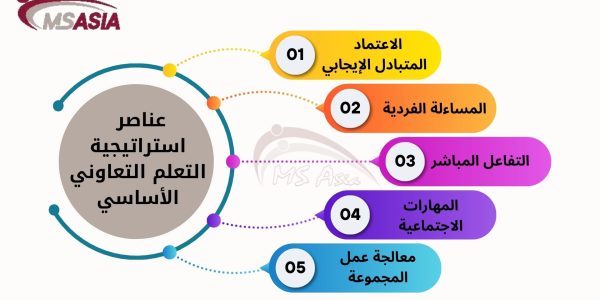
What are the elements of a basic cooperative learning strategy?
The basic collaborative learning strategy consists of several main elements that enhance interaction between students and effectively achieve educational goals. Here are the basic ingredients:
Positive Interdependence
● Students feel connected to each other to achieve a common goal, as the success of an individual depends on the success of the group.
This is done by distributing roles, tasks, or resources so that each member needs others.
2- Individual accountability
● Each student is responsible for his learning and contribution to the group’s work
● The individual is evaluated separately to ensure that he is not dependent on the efforts of others.
3- Face-to-face Interaction
● Provides students with opportunities to face-to-face communication, such as discussions and exchange of ideas, which promotes critical thinking and problem-solving.
-4 Social skills
● Teach students collaboration skills such as: effective communication, conflict resolution, and mutual respect to ensure that the group works in harmony.
5- Group processing work
● Evaluate the group’s performance periodically to determine strengths and weaknesses, and improve future cooperation.
The importance of these components:
Working together to create an active learning environment where students develop academic and social skills, and enhance self-confidence and ability to work in a team.
How can I prepare using a collaborative learning strategy?
1- Preparation stage:
● Define the educational goals clearly (academic and social), such as: understanding a scientific concept, or developing communication skills.
● Design tasks to be divisible into group activities and require cooperation (e.g. complex problem solving, project design, case discussion).
● Divide the students into small groups (3–5) individuals, taking into account:
● Diversity in abilities and backgrounds to enhance integration
● Distribution of roles within each group (leader, recorder, presenter, evaluator..)
2- Implementation stage:
A. Explanation of the task and the rules of the work:
Explain the groups to be required to implement, and the specified time
He stressed the importance of mutual dependence (the task can only be accomplished with the cooperation of all).
Remind them of individual accountability (each member is responsible for his learning and contribution).
b. Providing resources and tools:
Deliberately distribute materials or resources (for example: each member gets part of the information to complete the overall picture).
C. Facilitate interaction:
Encourage discussions face-to-face, and use activities such as:
o Round Table: Each member shares an idea
o Mutual group learning: peer teaching within the group.
Monitor groups and enter when you need to direct discussion or conflict resolution.
3- Follow-up and evaluation stage:
Group evaluation:
o Final production (e.g. report, presentation).
o Use clear criteria (example: content quality, creativity, collaboration).
Individual evaluation:
o Ask each student to evaluate himself and his colleagues (using a questionnaire or checklist).
o Test them individually to ensure that they understand the content.
Discuss the performance of the groups:
o Ask them about the challenges they faced and how to improve cooperation in the future
4-Applied examples of collaborative activities:
In science: design groups, modeling for an ecosystem and a common explanation.
In Arabic: groups that discuss a story and write an alternative end together
Mathematics: Solve complex problems so that each member solves a part and teaches it to others
Tips to achieve success:
Choose tasks that stimulate critical thinking, not just direct answers.
Train students on social skills (like listening and respecting opinions) before starting.
Use various evaluation tools such as: Rubrex, written notes, or video recordings of discussions.
Reward the collective effort with an emphasis on individual contribution
With these steps, the classroom is transformed into an interactive environment where students become active partners in the learning process, enhancing their intake of information and developing their life skills.

1- Designer of the educational environment:
Dividing groups:
Students choose and distribute them into homogeneous or varied groups (as per the objective), taking into account the balance in social abilities and characteristics.
Define cooperative tasks:
Designs activities that require real collaboration (such as solving complex problems, group projects, or targeted discussions).
Role distribution:
It defines roles within each group (eg: the leader, the recorder, the presenter, the evaluator) to ensure everyone’s participation.
2- Facilitator:
Directing groups:
Explain the tasks clearly, and define the rules of the work (example: time, how to participate, respect for opinions).
Strengthening mutual dependence:
Designs the tasks so that each member needs others (such as the distribution of information or interconnected tasks).
Motivating critical thinking:
It asks open questions that encourage students to analyze and discuss rather than ready answers.
-3 Observer & Supporter:
Interaction control:
He wanders between groups to notice the progress of work, and supports the groups facing difficulties
Providing feedback:
Provides instant feedback to improve performance (such as: “I noticed that some members did not participate, how can they be supported?”).
Conflict resolution:
He intervenes tactfully when disagreements arise to teach students problem-solving skills (such as using dialogue instead of screaming).
4- evaluator (assessor):
Group evaluation:
Group production (e.g. project quality, members collaboration) is evaluated using tools such as rubric.
Individual evaluation:
Verify that each student understands the content through individual tests or personal reports.
Social skills assessment:
It monitors communication skills, respect, and time management, and provides feedback about it.
5- Skills Trainer:
Teaching collaboration skills:
He trains students with skills such as:
o Effective listening
o Time management
o Providing constructive criticism
o Conflict resolution
A role model:
Shows co-operation behaviors by respecting students’ opinions and encouraging dialogue
6- Motivator:
Strengthening confidence:
Encourages shy students to participate and praise the collective and individual effort.
Linking learning to reality:
Explains how collaborative skills are useful in working life (such as working in a team).
7- Reflective Practitioner:
Self-assessment:
Rate the effectiveness of the lesson after its end: What succeeded? And what needs improvement?
Modify the plan:
He develops his strategies based on his feedback and feedback from students.
Practical example:
If you ask the groups to design a presentation on climate change:
1. The task is designed so that each member needs to research a different aspect (environmental impacts, solutions, and international experiences).
2. She intervenes to help a group that has difficulty dividing tasks.
3. The presentation is based on the quality of the content and collaboration, and evaluates each student through individual questions about the aspects they have discussed.
1. Early Childhood (Kindergarten and Primary) to suit the nature of learning through play
2. Teaching abstract or complex concepts to simplify them (such as mathematics or science).
3. Increase students’ motivation and make learning fun when they notice their apathy.
4. Social skills development (cooperation, communication) or motor skills.
5. Teaching languages or integrating technology (such as digital educational games).
6. Indirect assessment of students’ understanding without stress tests
Cooperative Learning Strategy Objectives
The objectives of the cooperative learning strategy are to weave the threads of knowledge and skills together in the classroom, where the small groups turn into live workshops in which students interact in harmony. Instead of learning a stream of information that is in their minds, it becomes a mutual dialogue that enriches and deepens understanding. They build concepts collectively. In the midst of this interaction, the communication skills of plants grow in fertile soil. They learn how to express their opinions with confidence, listen to others with respect, and turn disagreements into opportunities to learn rather than sources of conflict.
It does not stop at academic knowledge, but extends to instilling the values of responsibility, as each individual feels that the success of the group depends on his efforts. At the same time, the differences between the students are melting, and the superior will find the opportunity to hone his leadership by helping his peers, while the weak gain new confidence when he touches the group’s support for him. This is how the strategy brings students from the shell of individuality to the collective work space, preparing them for an external world where there is no place for secluded work, but rather requires cooperation, creativity, and the ability to solve problems with an open collective mind.
Thus, the classroom becomes a laboratory for the manufacture of students who are not only carrying information, but as active individuals in their community, capable of transforming challenges into opportunities, and complexities into solutions, with collaborative hearts and integrated minds.
The difference between the collaborative learning strategy, the traditional learning strategy
| comparison | Cooperative Learning Strategy | traditional learning strategy |
| The responsibility | Individual and group responsibility: each member is responsible for his own learning and for helping his colleagues learn and achieve the group’s goals. There is a positive mutual dependence. | Individual Responsibility: The learner focuses only on his own learning. There is no responsibility for learning others or the group’s performance as a whole. |
| Group homogeneity | Heterogeneous groups: The groups are configured to include members who vary in abilities, personality, and backgrounds. This diversity enriches the learning process. | Homogeneous groups (often) are often largely the same in abilities, especially if students are grouped based on their academic level. |
| interaction | Active and direct interaction: encourages continuous communication, exchange of ideas and discussions among group members. The focus is on building positive relationships and social skills. | Limited interaction (mostly): the interaction between the teacher and the student is mostly individually. There may be some interaction between students, but it is not systematic or systematic required. |
| The role of the learner | Active and participant learner: The learner plays an active role in the learning process, as he explains, explains, assists and provides feedback to his colleagues. It becomes part of the building of knowledge. | Negative learner (mostly): the learner is often a recipient of information from the teacher. His role is less active in the knowledge-building process. |
| teacher’s role | Facilitator and Moderator: The teacher focuses on facilitating the learning process, directing groups, providing support when needed, monitoring interaction, and providing feedback at the group and individual level. | Knowledgeable and source of knowledge: The teacher is the main source of knowledge and transmits it directly to the students. Focuses on providing information and evaluating individual understanding. |
| The focus | Focus on the process and product: the focus is on how the group works together (process) and the final product of the collaboration (product). Teamwork and communication skills are appreciated. | Product Focus: The focus is mainly on the final output of individual student learning (exams, individual assignments). |
| social skills | Social Skills Development: Social skills such as effective communication, listening, conflict resolution, leadership, and teamwork are taught and encouraged as an essential part of the educational process. | Less emphasis on social skills: the focus is often not on the development of social skills. Students may learn some of these skills indirectly. |
| evaluation | Multidimensional evaluation: includes individual performance evaluation and contribution to the group, as well as evaluation of the group’s performance as a whole. It may include peer assessment and self-assessment. | Individual assessment: the evaluation focuses primarily on individual student performance through individual tests and assignments. |
| motivation | Internal and external motivation: motivation is enhanced by a sense of belonging to the group, shared responsibility, collective success, and individual appreciation. | External motivation (mostly): Motivation depends heavily on the grades and grades obtained by the individual individually. |
Article summary:
The article deals with a collaborative learning strategy as an educational approach based on dividing students into small groups to achieve common educational goals, with an emphasis on collaboration rather than competition. The article explains:
1. Definition of Strategy: An approach that enhances interaction between students through positive mutual dependence, individual accountability, direct interaction, social skills development, and group performance evaluation.
2. Its main components are: mutual dependence, individual accountability, direct interaction, social skills, and group work.
3. How to prepare for it: Goal Setting, Task Design, Group Divide, Resource Providing, Facilitating Interaction, and Performance Evaluation.
4. The role of the teacher: the educational environment designer, the interaction facilitator, the observer and the supporter, the assessor, the skills trainer, the motivator, and the strategy rate.
5. The learner’s role: active participant, individual responsible, cooperative, supportive, and innovative problem-solving.
6. Uses of learning by playing: in early childhood, simplifying complex concepts, increased motivation, and skills development.
7. Strategy Objectives: Strengthening deep understanding, developing communication skills and teamwork, instilling responsibility, and preparing students for teamwork in real life.
8. Research study: Analysis of the effectiveness of cooperative learning in teaching English speaking, with a review of strengths (increased confidence, improved skills) and weakness (noise, dependence on outstanding students).
