
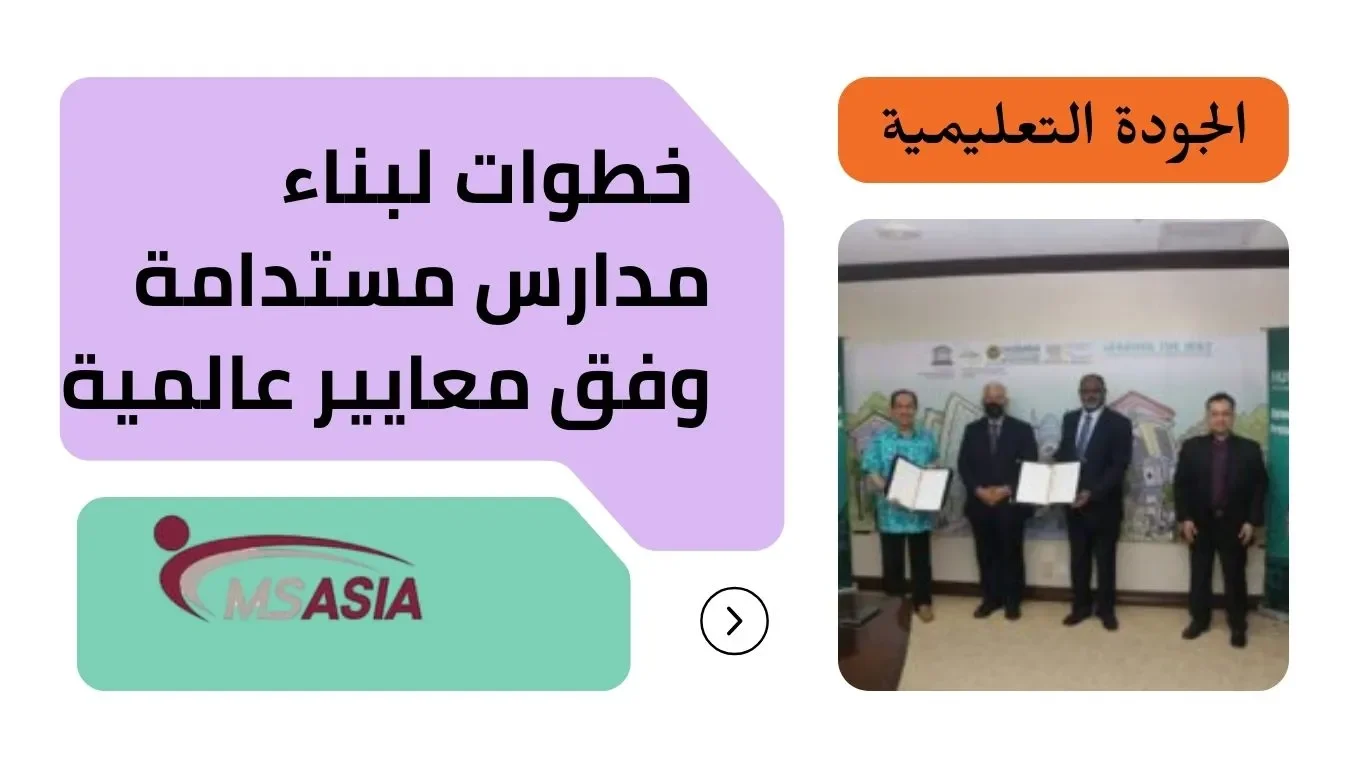
الجودة التعليمية خطوات لبناء مدارس مستدامة وفق معايير عالمية
Education is the basis for the progress of any society, but not every education achieves the desired goals! Educational quality means that we provide students with a comprehensive educational experience that develops their mental and social skills, and provides them with knowledge and values that make them able to meet life’s challenges.
Think of a school that provides interactive classes, trained teachers, reality-related approaches, and a safe environment that encourages creativity… These are educational quality elements that ensure that education is not limited to “information of information”, but rather a process that inspires students to think. Critical, self-learning, and contributing to building a better society.
Educational quality is the way to an education that not only changes the lives of students, but also the world around them.
The concept of educational quality
It is an integrated educational system based on: modern approaches that link knowledge to application. To build people capable of leading change, and prosperous communities facing challenges with science and humanity.
The importance of building the future
1. Empowering individuals:
-
Developing skills such as critical thinking, creativity, and adaptation to change, which enhance employment and entrepreneurship opportunities.
-
Building morally and socially responsible personalities, capable of participating in community building.
2. Pay the economy:
-
Creating a generation capable of innovation in areas such as artificial intelligence and renewable energy, which stimulates economic growth.
-
Reducing unemployment by qualifying cadres that meet the needs of the changing labor market.
3. Strengthening social stability:
-
Fighting poverty and inequality by providing fair educational opportunities.
-
Promoting the values of tolerance and citizenship, which reduce conflict, support societal cohesion.
4. Facing global challenges:
-
Preparing future leaders who are able to solve problems such as climate change and health crises through scientific research and international cooperation.
-
Achieving the Sustainable Development Goals (e.g. Goal 4: Quality Education).
5. Global competition:
-
Countries like Finland and Singapore have made economic booms thanks to their investment in quality education, making them a role model.
Global Quality Standards in Education: A Comprehensive Reference Framework
Global quality standards in education are a map for the development of educational systems, ensuring excellence and justice, and keeping pace with the requirements of the times. These standards are based on international reference frameworks such as UNESCO standards, or an organization OECDThe World Bank is applied through various educational institutions to measure effectiveness and improve output.
The most prominent components of the comprehensive reference framework for global educational quality
1. Clear Vision and Strategy:
-
Setting specific and measurable educational goals, in line with the needs of the community and the labor market.
-
Linking the curriculum to the Sustainable Development Goals (e.g. Goal 4: Quality Education).
2. Professional competence for teachers and administrators:
-
Qualifying teachers through continuous training programs that focus on:
-
Interactive teaching methods such as project-based learning
-
The use of technology in education.
-
Culturally diverse classroom management skills.
-
3. Flexible and Accompanied Curriculum:
-
Integrating life skills such as critical thinking, problem solving, and teamwork.
-
Including modern areas such as: artificial intelligence, financial education, and environmental education.
4. Infrastructure and Supporting Techniques:
-
Providing smart classes, advanced laboratories, and digital educational platforms.
-
Ensure a safe and healthy environment, lighting, ventilation, and facilities for people with special needs.
5. Transparent and Effective Evaluation Systems:
-
Use of various evaluation tools (performance tests, achievement files, and practical projects).
-
Measure your learning outcomes (knowledge, skills, attitudes), not just inputs.
6. Community and International Partnerships:
-
Cooperation with the private sector to support educational programs.
-
Participation in international initiatives (such as the program Pisa to evaluate students).
7. Digital education and adaptation to the technological revolution:
-
Integrating technology into the educational process (Blue Education, Virtual Reality).
-
Developing open-source educational platforms (MOOCs) for lifelong learning.
8. Scientific research and innovation:
-
Encourage educational research to develop educational theories and practices.
-
Connecting universities, innovation centers and the industry sector.
9. Sustainable Quality:
-
Review educational policies periodically based on feedback.
-
Total Quality Standards (TQM) application in school administration.
Examples of a global reference framework
-
UNESCO Education Framework 2030: Focuses on Equity and Lifelong Learning.
-
international accreditation standards (e.g. Neasc Or IB)The institution requires that the institution comply with specific international standards.
-
European Excellence Model (EFQM)Institutional performance is evaluated through axes such as leadership and partnerships.
Challenges in applying global standards
-
Cultural and economic differences between countries.
-
Lack of funding or qualified cadres in some areas.
-
Difficulty measuring the long-term impact of educational quality.
Why are these criteria necessary?
-
To meet the challenges of the Fourth Industrial Revolution, artificial intelligence.
-
To build generations capable of dealing with global crises and climate change
-
To achieve economic competitiveness between countries.
Sustainability in Education: An Integrated Vision for Sustainable Development
Sustainable development in education seeks to provide opportunities for quality education, regardless of gender, race, religion or culture; It aims to achieve equality in educational opportunities and reduce student gaps; Sustainable development in education enhances social justice and contributes to building more developed and prosperous societies.
Steps to build sustainable schools according to international standards
1. Developing sustainable educational curricula:
1. Linking sustainability to all elements of the curriculum:
-
Sustainability is not limited to separate activities, it should be part of:
-
Educational objectives (eg: promoting environmental awareness).
-
Content (inclusion of case studies on environmental challenges in Kuwait).
-
Evaluation (measuring the impact of students’ projects on society).
-
2. Clarify the role of the organizational structure in supporting sustainability:
-
Establishing the Ministry’s digital platforms to exchange best practices between schools in implementing green projects.
-
Training teachers on sustainability teaching methods through workshops in partnership with international institutions (e.g. the United Nations Environment Programme).
3. Taking into account the age differences in the design of activities:
-
Primary school: simple activities (cultivation of classroom plants).
-
Secondary stage: complex projects (designing a smart recycling system using IOT technologies).
4. Adding a technological dimension:
-
The use of artificial intelligence to analyze the school’s carbon emissions data (integrating mathematics with technology).
-
Employing Virtual Reality in Arts to design interactive awareness campaigns.
incorporation Phenomenon Break climate In a Curriculum educational to achieve Scoring development sustainable
2. Empowering educational cadres:
An essential pillar for building a just educational system, through which the state translates its commitment to ensuring educational justice and general enrollment without class or discriminatory barriers. This vision is manifested through a package of effective mechanisms that transform teachers into two drivers of change, such as:
-
Specialized workshops to integrate the concepts of sustainability into the curriculum through interactive methods that integrate creativity with knowledge.
-
Intensive training programs to use green technology such as AI environmental data analysis to enhance their skills in keeping pace with global transformations.
-
Creative incentives such as awards for best sustainable class practices, turn classes into responsible learning laboratories.
These steps not only enhance the competence of teachers, but also establish a culture of excellence and equality, and create a generation that is aware of its ability to use knowledge to meet challenges, within the framework of a comprehensive education that enshrines the principle of “equal opportunities for all”.
3. Promote community participation:
A vital support for building a comprehensive and capable education, as educational institutions are transformed into bridges linking the needs of society and the goals of sustainable development. The state adopts innovative mechanisms to activate this role, such as:
-
Strategic partnerships with community institutions (such as associations and startups) to design educational programs that meet market needs and enhance social values.
-
Interactive awareness campaigns (using digital platforms such as M-S-CI and field workshops) to enable families to support the educational process, such as “School Without Waste” or “Green Class” initiatives.
-
Intelligent volunteer platforms that facilitate the involvement of experts and volunteers in providing quality training for students (such as technological education or sustainable craft skills).
These mechanisms not only transform society into an active partner in the education industry, but also strengthen belonging and develop a sense of shared responsibility, creating an integrated social fabric that supports attractive and sustainable education, and is dedicated The principle that “education is everyone’s responsibility.”
4. Sustainable Assessment Systems:
A fair and responsible education engine that integrates the academic performance measurement while promoting environmental and social values through:
-
Dynamic assessment (using artificial intelligence) to analyze student data and carbon footprint control.
-
Comprehensive indicators linking educational attainment to life skills (resource management and teamwork).
-
Participatory platforms engage the family and society in evaluating the quality of education through smart applications.
-
The Sustainable Excellence Awards for Schools Achieving Academic Excellence with Energy Efficiency.
These systems reshape the culture of education to be transparent and proactive, and transform schools into micro-models of sustainable societies, which believe that “successful education builds people and society.”
5. Smart educational platforms:
Use applications such as “Eco-Schools” to manage environmental projects.
Virtualization of scientific experiments that reduce the use of chemicals.
Digital School Administration:
Converting administrative processes into electronic systems to reduce the use of paper.
Ensure justice and inclusive
Integrating the principles of free or supported education and comprehensive facilities with sustainability-supporting technology promotes social justice and access to quality education for all, and is one of the SDG 4 goals. Here is a detail of how to achieve this using innovative solutions: smart educational platforms:
Use applications such as “Eco-Schools” to manage environmental projects.
Virtualization of scientific experiments that reduce the use of chemicals.
Digital School Administration:
Converting administrative processes into electronic systems to reduce the use of paper.
6. Ensure all educational justice inclusive of all through technology and sustainability
(SDG4 Sustainable Development Goal Support)
1. Free/Supported Education for the Less Fortunate Categories:
-
Free digital platforms:
-
Providing free open courses (e.g. Coursera) + Internet cost support.
-
Partnerships with scholarship financing companies.
-
-
Solutions for remote areas:
-
Solar Spell (e.g. Solar Spell) works without the Internet.
-
Community solar charging centers.
-
2. Comprehensive study facilities for people with disabilities:
-
Financial facilities:
-
Slopes, suitable lighting, equipped bathroom cabins.
-
-
Auxiliary technology:
-
Eye control devices, screen readers (such as NVDA), AI applications for dyslexic.
-
3. Integrating sustainability with education:
-
Environmentally friendly schools:
-
Installing solar panels on surfaces + LED lighting is provided.
-
-
Green skills training:
-
Courses in recycling and maintenance of solar panels.
-
4. Fast Challenges and Solutions:
challenges |
The solutions |
Solar costs |
Partnerships with international organizations (such as UNICEF). |
Lack of infrastructure |
Using technologies that work without an electricity network (such as solar batteries). |
poor quality of education |
Remote teacher training via Zoom or Teams. |
5. Globally Successful Models:
-
A computer per child (OLPC project): cheap devices for children in remote areas.
-
Microsoft Solar Seasons: Solar Powered Seasons with Internet.
-
Khan Academic Platform: Free Lessons in 40 Languages + Tools for People with Disabilities.
-
MS Asia offers many educational services, such as MS Asia, which provides continuous courses in Arabic, English and Malay for non-speakers, to prepare, train and develop.
Innovative ways to achieve sustainability in schools globally
Inspirational models from 7 different countries
Classified by Sustainability:
The form |
country |
The most prominent solutions |
The influence |
green school |
Bali, Indonesia |
• Buildings of bamboo and mud.Environmental curriculum.• Hydroelectric and solar energy. |
Reducing the carbon footprint.Promote community awareness. |
Osu Nero School |
Kenya |
350,000 liters of rain water is collected annually.Clay tanks for irrigation. |
Achieving water sufficiency.Support sustainable agriculture. |
Washington University |
United state |
100% renewable electricity.• Study courses in sustainability.The goal of carbon neutrality. |
Reducing emissions.Qualifying future leaders. |
Australian school |
Singapore |
• 1000 solar panels.Integrating sustainability into the curriculum. |
Generate clean energy.Practical education of environmental challenges. |
Vaginningen University |
Netherlands |
Sustainable Agriculture Research.Organic food in canteens. |
Develop sustainable food solutions.Public health support. |
The most prominent sustainability categories in models:
clean energy:
-
Solar panels (Singapore, America).
-
Carbon neutrality policies (California, Washington).
2, Resource Management:
-
Rain water collection (Kenya).
-
Environmentally friendly buildings (Bali, California).
3. Applied Education:
-
Environmental-focused approaches (Bali, Singapore).
-
Scientific research (Netherlands, Malaysia).
