March 1, 2026
How to Create Concept Maps
The concept map is a visual tool that helps in an orderly representation of knowledge, whether it is hierarchical or mesh. Relationships between different concepts appear in a particular topic, making them useful for understanding and analyzing complex information. For example, they can be used to associate concepts such as “cells” and “cellular breathing” with bonded words such as “leading to”.
The benefits of using it
Conceptual maps enhance deep understanding, facilitate information retrieval, and develop analysis skills. For example, students can use science lessons, while professionals can use it to analyze the company’s operations.
Understanding the concept map
Concept Map is a visual tool developed in the 1970s by Joseph de Novak and his team at Cornell University. Initially, the tool was intended to represent students’ understanding of science concepts, inspired by David Osole’s moral learning theory, which emphasizes linking new knowledge to previous knowledge. Today, it is used in various fields such as education, business, and knowledge management.
Theoretical foundations
Concept maps are based on Osubel’s moral learning theory, which focuses on the importance of linking new information to existing knowledge structures. It is also in line with constructivist theories, where the learner actively builds his understanding by linking ideas. This approach promotes active learning and critical thinking, making maps a powerful tool for developing cognitive skills.
Components of the concept map
-
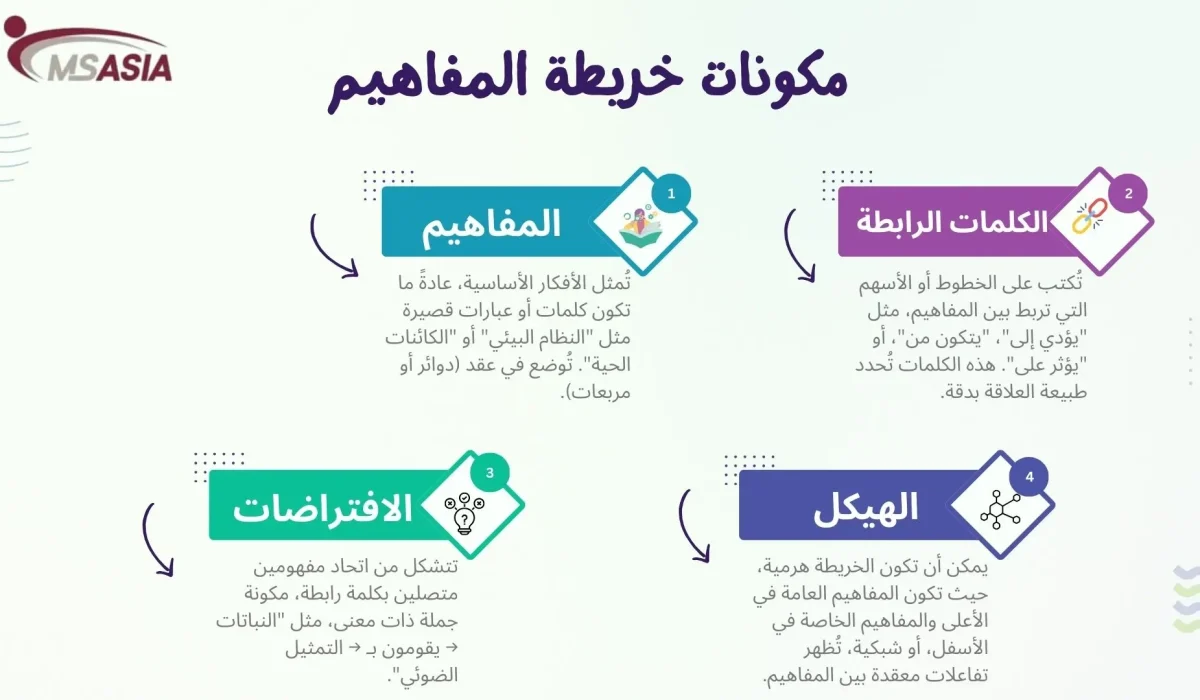
Concepts: Basic ideas are usually short words or phrases such as “ecosystem” or “living organisms”. Placed in knots (circles or squares).
-
Linked words: written on lines or arrows linking concepts, such as “lead to”, “constituted from”, or “affects”. These words accurately determine the nature of the relationship.
-
Assumptions: It is formed by the union of two concepts connected to the word bond, forming a meaningful sentence, such as “plants → they do → photosynthesis”.
-
Structure: The map can be hierarchical, where the general concepts are at the top and the specific concepts are at the bottom, or networks, showing complex interactions between the concepts.
Types of Concept Maps
-
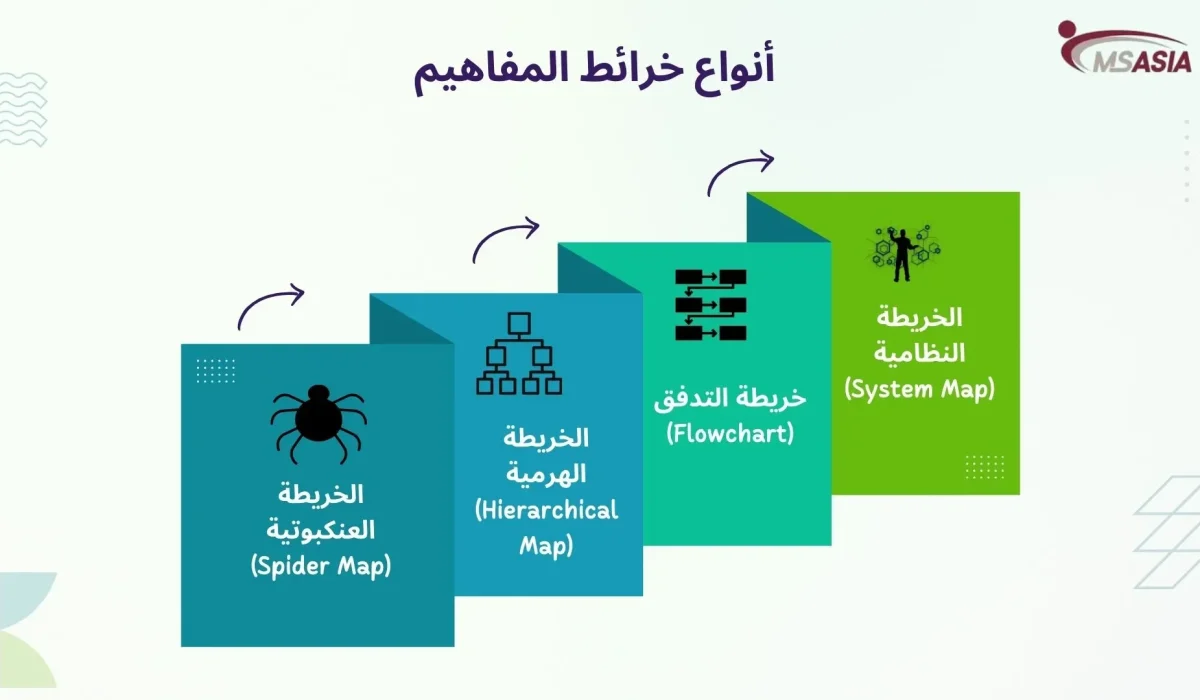
spider map (spider map)It starts with a central idea, from which sub-concepts branch out, ideal for brainstorming sessions.
-
hierarchical mapHierarchical map)The concepts are arranged from the most general to the most specialized, suitable for classifications such as biological classifications.
-
flow map (flowchart)It shows the sequence of processes or events, such as the phases of the water cycle.
-
Regular mapsystem map)It focuses on interactions between system components, such as how the ecosystem parts interact.
Benefits of using concept maps
-
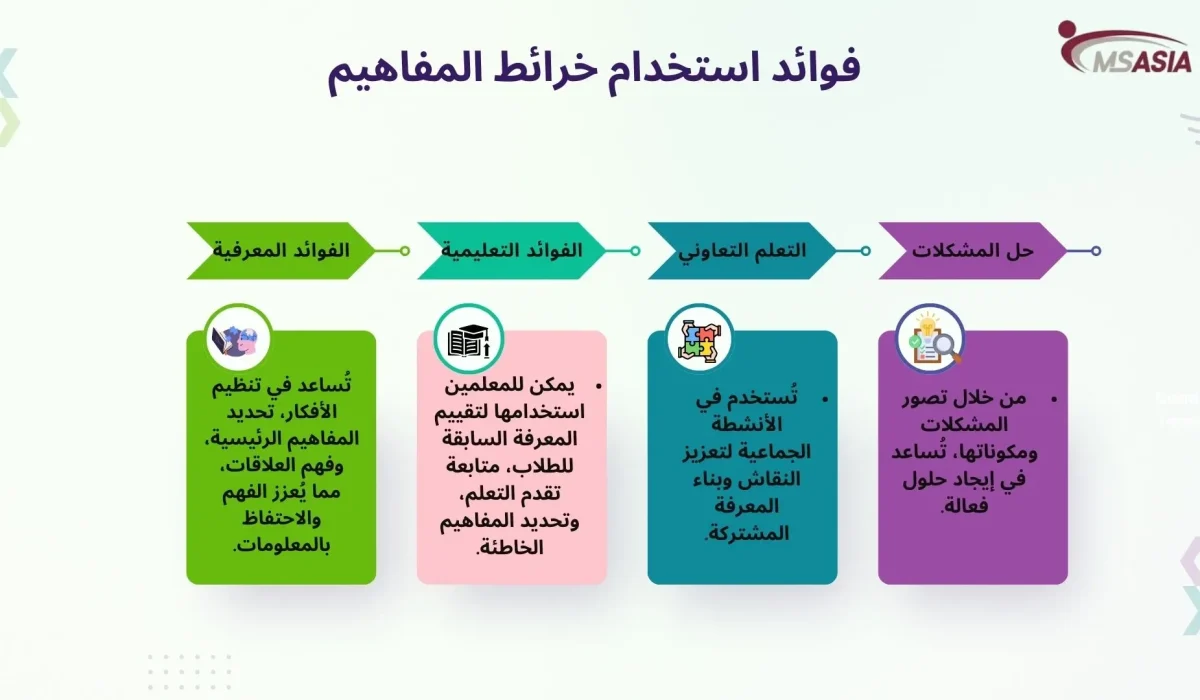
Cognitive Benefits: Helps organize ideas, define key concepts, and understand relationships, which enhances understanding and information retention.
-
Educational Benefits: Teachers can use them to evaluate students’ past knowledge, follow the progress of learning, and identify misconceptions.
-
Cooperative Learning: It is used in group activities to promote discussion and build common knowledge.
-
Problem-solving: By visualizing problems and their components, they help find effective solutions.
How to Create a Concept Map: A Practical Guide
-
Domain selection: Select the subject you want to represent, such as “Solar System”.
-
Define the main concepts: Write a list of basic concepts, such as “Sun”, “Planets”, “Moons”.
-
Arrange the concepts: rank them from the most comprehensive to the most specialized.
-
Connect the concepts: draw lines or arrows between related concepts, and add bonded words such as ‘Turn around’.
-
Review and improve: Make sure the relationships are accurate and structure clear, and add colors or symbols to improve optical appeal.
Examples of using concept maps
-
Education: Summarizing a science lesson, such as linking “cells” to “nucleus” with the word “contains” association.
-
Business: Analysis of the company’s operations, such as linking “marketing” to “sales” with “leading to”.
-
Scientific research: the organization of theoretical ideas, such as linking “the theory of relativity” to “gravity” with “explain”.
digital tools for creating concept maps
-
CmapToolsA free program tailored to concept maps, supports collaboration and resource linking.
-
MindmeisterA collaborative platform that can be adapted to create concept maps with flexible structure.
-
LucidchartA versatile graphics tool that supports concept maps among other types of graphics.
-
CanvaProvides concept map templates with attractive designs, with an emphasis on the visual aspects.
The difference between the concept map and the mind map
-
Focus: The mind map focuses on one central idea with unoriginal branches, while the concept map shows multi-directional relationships between multiple concepts.
-
Structure: Mind maps are radial and less organized, while concept maps are more structural with a clear definition of relationships.
-
Purpose: Mind maps are often used to generate ideas and creativity, while concept maps are used to understand and represent the structures of knowledge.
Research and effectiveness
Studies have shown the effectiveness of concept maps in education. For example, an analytical study of Nespet and Adisop (2006) found that concept maps have a positive impact on students’ achievement across different educational levels and materials. The visual and organizational aspects of concept maps help learners to integrate new information with existing knowledge, leading to better understanding and retention.
Integration in teaching and learning
Teachers can integrate concept maps into teaching strategies in different ways:
-
Pre-Evaluation: Use it to measure students’ past knowledge before starting a new topic.
-
During education: students are asked to create while learning maps to organize new information.
-
After education: use as a review tool or for evaluation purposes.
-
Cooperative Activities: Encouraging teamwork to build maps, which promotes debate and peer learning.
Challenges and solutions
Common challenges include:
-
Initial difficulty: Students may find it difficult to get started, especially if they are used to writing notes.
-
Solution: Provide examples and templates to guide them.
-
Wrong representation of relationships: an inaccurate link may lead to misunderstanding.
-
Solution: Encourage peer review and comment.
-
Excess complexity: the maps may become crowded if they are not well managed.
-
Solution: Teach students to focus on key concepts and relationships, while avoiding unnecessary details.
Conclusion
Concept maps are a versatile tool for visualizing and organizing knowledge. By representing the relationships between concepts, it facilitates a deeper understanding, enhances the retention of information, and develops critical thinking. Whether in educational, business, or personal planning contexts, concept maps provide an organized and flexible way to manage information. With the development of digital tools, creating and sharing concept maps has become easier, extending its usefulness. It encourages the adoption of concept maps to achieve more moral learning experiences and improved problem-solving skills.