
مستقبل التعليم المدمج: تحولات جذرية في ظل التكنولوجيا والذكاء الاصطناعي
Blended Education is a formal learning program that combines education in class with a teacher and online learning. In this program, the student receives education through the Internet in part as well as within the classroom with the teacher. In this way, the student controls the learning time, place, path, and speed of progress more than the traditional educational programs. Defenders of this method have two advantages that activate learning: the ability to collect data about students’ learning, to allocate teaching materials and exams that suit students’ learning styles.
What is blended education?
Blended education is not purely traditional or electronic, but rather intelligently integrates them. It starts in the classroom and extends digitally with interactive activities and platforms that allow the student to control the pace of his learning. Depends on a well-thought-out design that determines the facet and electronic content, the teacher turns into a guide. Recording platforms students perform to customize their learning paths. Its application varies according to the context, but studies confirm its effectiveness and the superiority of students’ achievement in it. It is a necessity to shape the future of education and achieve a balance between humanity and technology, to produce learners who have the skills of critical thinking and self-learning.

The difference between Blended Learning, Hybrid Learning
The two terms are often used interchangeably, but they have differences in application and purpose. Here are the details:
1. Blended Learning:
-
Integrating the facet interaction (in the classroom) with digital (online) activities for all students at the same time.
-
The integration of the two environments (digital and relevance) into one educational path to promote understanding.
-
A student watches an online lecture at home, then discusses practical applications with the teacher in the classroom.
-
All students participate in the same tasks (From + Digital).
-
The digital part complements the face, and does not replace it completely.
-
2. Hybrid Learning:
-
Divide the students into two groups:
-
A group attending the classroom.
-
A group that participates by default online (at the same time).
-
-
Providing the flexibility of attendance for students (choice of attendance in person or remotely).
-
Example: a teacher explains a lesson to students in the classroom, while the explanation is broadcast directly to other students at home via
-
The content itself is provided to all students, but the way of participation is different.
-
There may be no integration between digital and relevance activities.
-
The differences
standard |
blended education |
hybrid education |
The target |
Improving the quality of learning through integration. |
Providing flexibility in the way of attending. |
Community |
All students participate in both activities. |
The students are divided between the presence of the face and the virtual. |
interaction |
synchronous and asynchronous reaction. |
Synchronous reaction (real time). |
The role of technology |
Complementing the semester. |
A tool to connect content to remote participants. |
Example |
Inverted chapter (Flipped Classroom). |
Live broadcast of students’ lessons at home and classroom. |
Why are they confused?
-
The two models are involved in the use of technology, but:
-
Blended Education: Integrating Activities to Achieving an Educational Goal.
-
Hybrid Education: Divide the students according to the method of attendance.
-
Principles of Blended Education: Combined Traditional and Digital.
Blended education is based on a conscious and balanced integration of traditional and digital education, as they complement each other. It gives the learner flexibility and control of his time, place and speed of progress while maintaining an essentially substantive interaction. Depends on the customization of learning based on performance data analysis using digital tools. Dual interaction enhances face-to-face and digital, and uses a continuous assessment that combines traditional and digital methods. Its essence focuses on achieving specific educational results, as technology or facet methods are used based on what serves the goal more efficiently.
Blended Education Designs and Designs
First: the main models
-
Inverted class form (Flipped Classroom):
-
reverse the traditional model; Students study theoretical content via online videos or interactive materials at home, while class time is devoted to practical activities and discussions.
-
The student watches a video about Newton’s laws at home.
-
In class, conducts practical experiments and discusses applications with the teacher.
-
platforms like youtube, Edpuzzle, or moodle.
-
Promote deep interaction rather than indoctrination.
-
rotation modelRotation Model):
-
Divide students into groups that move between different educational stations, some digital and some,
-
station rotation (Station rotation): Inside the same chapter (example: discussion station, video station, application station).
-
Laboratory Rotation (Lab Rotation): Move between the classroom and the computer room.
-
A group discussing a literary text with the teacher.
-
Another group is practicing grammar through a smart application.
-
Meet various learning styles at once.
-
Flexible Model (Flex Model):
-
The bulk of learning is left to the student via digital platforms, with teacher support when needed.
-
A vocational training student who studies subjects via an electronic platform, and asks for teacher help when facing difficulty.
-
High flexibility in time and path control.
-
Students of higher education or vocational training.
-
MS Asia applies the flexible model in its professional programs, where trainees study through dedicated e-courses (such as the FIDIC Contracts course), with weekly sessions with experts to solve practical problems.”
Second: Content Design (Balance between Attendance and Electronic)
To ensure the efficacy of integrated education, the content must be designed according to the following principles:
-
Strategic integration:
-
Determine which skills are taught on purpose (such as scientific experiments or critical discussions).
-
Choose what you can self-learn online (such as theoretical lectures or short exams).
-
Data usage:
-
Analyze the interaction of students with digital content to modify the face-to-face activities.
-
Example: If the data shows poor students’ understanding of a particular subject, the time for the chapter is devoted to an explanation.
-
Compact evaluation:
-
Integrating electronic tests (adaptive tests) with practical class assessments (such as presentations).
-
Mutual interaction:
-
Designing digital activities that stimulate the debate, such as:
-
Discussing students’ comments on an online forum during the lesson.
-
Use the results of the online competition as the basis for teamwork in the class.
-
-
Flexibility in design:
-
Providing multiple options for students (such as videos, text, or podcasts) to study the same topic.

Facial activity |
electronic activity |
The target |
group discussion |
Watch a video tutorial |
Understanding basic concepts |
Laboratory Experiment |
Interactive exercises |
The theories application |
Presentations |
Post in a discussion forum |
Promote critical thinking |
To achieve an effective balance between digital and facet components, a range of technological tools that facilitate interaction and content management are used. Here are the main classifications with practical examples:
First: Learning Management Platforms (Learning Management Systems – LMS)
- Organizing educational content, following up on student progress, and providing a central communication channel.
- The most famous examples:
- moodleAn open source platform that allows designing custom educational tracks and managing assessments.
- BlackboardIt is used in universities to support interactive tasks and virtual discussions.
- Google Classroom: Integrates seamlessly with Google Tools (such as Drive, Meet).
- Upload lectures, assignments, and educational resources.
- Generate reports on students’ participation and performance.
- MS Asia (MS AsiaAn effective model in supporting blended education, providing an integrated environment that combines digital content (such as recorded language courses) and facial interactions (workshops and conferences), with the design of programs to suit Asian contexts. And Arabic.”
Second: Direct Interaction Tools
-
Enable live communication between the teacher and the students, both in class or remotely.
-
The most famous examples:
-
Zoom: for virtual meetings, with features such as group work subrooms.
-
Microsoft Teams: Integrates chat, meetings, and file sharing in one place.
-
Google Meet: Easy to use with the possibility of direct recording.
-
-
Innovative uses:
-
Organizing live FAQ sessions.
-
Inviting remote experts to participate in the lessons.
-
Third: Self-Learning Resources (Non-Sync)
-
Enable students to learn according to their speed, while providing instant feedback.
-
The most popular tools:
-
Interactive videos:
-
EdpuzzleAdding questions and events within the video.
-
PlayPositTurn videos into interactive lessons.
-
-
Electronic Tests:
-
Quizizz: Fun tests with designing games.
-
KahootReal-time competitive competitions.
-
Google FormsTo create auto-correction tests.
-
-
digital simulation:
-
Phet (For physics and chemistry).
-
Labster (Virtual laboratories).
-
-
Fourth: Cooperation and Evaluation Tools
-
Promote teamwork and practical skills assessment.
-
Examples:
-
padlet: Virtual panel for sharing ideas and notes.
-
MiroInteractive white plate for brainstorming.
-
Flip (Formerly Flipgrid)Recording short videos for discussions.
-
Fifth: Artificial Intelligence ToolsAI)
-
Customize your learning experience and provide automated support.
-
Examples:
-
ChatgptTo answer students’ questions or to generate exercises.
-
Squirrel AIA adaptive learning platform that determines students’ weaknesses.
-
How to choose the right tools?
-
Define the educational goal: do you need a live interaction? An evaluation? Self-learning?
-
Integration: Ensure that the tools are compatible with each other (such as integrating Zoom with Moodle).
-
Ease of use: Choose tools with a simple interface to avoid the complexity of students.
-
Cost: Use free open source tools if the budget is limited.
Best Practices Integrating Tools:
-
Training: Qualifying teachers and students to use tools.
-
Feedback: Ask the students which tools are most useful to them.
-
Continuous modernization: tracking technological developments to develop the experiment.
Blended Education brings great benefits to both learners, who have the flexibility and personal interaction in their learning. and educational institutions, with financial savings and improvements in output quality with the possibility of expansion; and teachers, who can diversify their teaching methods, analyze students’ data and save their time. MS Asia institutions to achieve their development goals through dedicated training packages, such as leadership preparation programs or cybersecurity courses, which reduce costs and raise the efficiency of employees by up to approximately 40%.
Group |
The most prominent gains |
The educated |
Flexibility, interaction, custom learning. |
institutions |
Financial savings, output quality, expansion. |
teachers |
Innovative teaching methods, data analysis, effective time management. |
Blended Education Challenges and How to Overcome them
Blended education is not free from challenges, but understanding and confronting it is an essential part of ensuring its success. Here are the main challenges with practical solutions:
1. Technological challenges:
-
Challenge:
-
The lack of sufficient digital infrastructure (poor internet, devices that are not available to everyone).
-
Difficulty uniting the platforms used between teachers and students.
-
-
Solutions:
-
Providing borrowed devices or computer laboratories in the educational institution.
-
Using simple, low-speed internet platforms (e.g. Google Classroom).
-
Teacher training on open source tools (e.g. moodle).
-
2. resistance to change:
-
Challenge:
-
Teachers’ fear or distrust of technology.
-
Some students stick to the traditional methods.
-
-
Solutions:
-
Training teachers on educational technology skills (e.g. TOT courses).
-
Provide incentives for creative educators to use embedded forms.
-
Involve students in designing the experiment to increase their acceptance (e.g. polls).
-
3. Difficulty achieving balance:
-
Challenge:
-
Excessive use of technology at the expense of human interaction, or vice versa.
-
Difficulty determining the optimal ratio between the digital and the face-to-face components.
-
-
Solutions:
-
Adoption of a flexible hybrid model that adapts to the nature of the material (eg: practical materials need more presence).
-
Analysis of students’ interaction with digital content, proportionality modification.
-
4. The quality of digital content disparity:
-
Challenge:
-
The presence of weak or unattractive digital content.
-
Content is not suitable for different educational styles (visual, audio, and motor).
-
-
Solutions:
-
Adopt quality standards for digital content (voice clarity, interactivity, periodic update).
-
Use tools to create various content (e.g. Canva to design, H5P for interactive activities).
-
5. Efficiency Measurement:
-
Challenge:
-
Difficulty evaluating the impact of integrated education due to the diversity of activities.
-
There are no clear performance indicators.
-
-
Solutions:
-
Use data analysis tools (e.g. Google Analytics for platforms).
-
Design periodic surveys to measure student and teacher satisfaction.
-
6. Psychosocial challenges:
-
Adjustment:
-
Students feel isolated in the digital part.
-
Difficulty building cooperative relationships between students online.
-
-
Solutions:
-
Integrating virtual collaborative activities (e.g. group projects across Miro Or padlet).
-
Allocate time in class to enhance social bonding (such as educational games).
-
Platforms like mother s Analto bridge the infrastructure gap by providing offline copies.Offline) is an educational material, especially in remote areas, with teachers training to use simple tools such as WhatsApp to deliver content.”
-
How do you turn challenges into opportunities?
-
Tech Challenges → Partnership Opportunity with Technology Companies.
-
Anti-change → An opportunity to build an institutional culture that supports innovation.
-
Quality Disparity → An opportunity to qualify cadres specialized in content design.
Blended education is not an abstract theory, it has transformed educational experiences around the world. Here are vivid examples from different fields:
1. Case study: Harvard University (US)
-
Context: Teaching an “Introduction to Computer Science” course for undergraduate students.
-
The challenge: the increase in the number of students (more than 1,000 students) and the difficulty of meeting their individual needs.
-
Compact solution:
-
Facial education: weekly lectures focusing on solving complex problems.
-
digital education:
-
Platform Edx To watch the recorded theoretical lectures.
-
Adaptive tests via Gradescope To assess instant understanding.
-
-
Interaction: Discussion Forums on Piazza To answer the students’ questions.
-
-
Results:
-
Decreased failure rate by 25%.
-
Significant improvement in practical programming skills.
-
2. Case Study: The Academy of Technology (Singapore)
-
Context: Teaching mathematics to high school students.
-
Challenge: varying levels of students in one semester.
-
Compact solution:
-
rotation modelRotation Model):
-
Station 1: Self-learning via the application Khan Academy (Adapts to the level of each student).
-
Station 2: Group activities in the classroom to solve applied problems.
-
Station 3: Individual sessions with the teacher for stalled students.
-
-
Evaluation: Use application data to identify educational gaps.
-
-
Results:
-
Average grades improved by 35% In one year.
-
Increased participation of weak students by 50%.
-
3. Case study: Siemens (Germany)
-
Context: Training of employees on renewable energy systems.
-
Challenge: the difficulty of gathering employees from different branches around the world.
-
Compact solution:
-
Virtual Training: Simulation of Power Systems via Platform Siemens xcelerator.
-
Facial training: operational workshops at the headquarters (once every 6 months).
-
Collaboration: use Microsoft Teams To make discussion groups between employees.
-
-
Results:
-
Reduce training costs by 40%.
-
Increasing the efficiency of employees in implementing projects 60%.
-
4. Case study: Cleveland Clinic Hospital (US)
-
Context: Training of doctors on fine endoscopic surgery.
-
Challenge: Limited hands-on training opportunities due to risks to patients.
-
Compact solution:
-
Digital Education: Theoretical Lectures Coursera About surgery techniques.
-
Practical training: the use of VR Simulations in laboratories.
-
Evaluation: Virtual Reality Performance Tests.
-
-
Results:
-
Reducing surgical errors 20%.
-
Training 500 doctors annually with high efficiency.
-
5. Case Study: Edraak Center (Jordan – Regional Education)
-
Context: Teaching English to young people in remote areas.
-
The challenge: the lack of qualified teachers and the weak infrastructure.
-
Compact solution:
-
Digital Education: Lessons Recorded via the Edraak Platform with Interactive Exercises.
-
Facial education: weekly sessions in community centers with volunteers.
-
Support: Application WhatsApp To answer daily questions.
-
-
Results:
-
The program reached 10,000 learners in two years.
-
Conversational skills improved by 45% Participants have.
-
What do we learn from these studies?
-
Context adaptation: each experience varies according to needs (academic, training, community).
-
Tools are not a goal: success depends on how you integrate them to achieve specific goals.
-
Data Axis Optimization: Interaction Analysis Helps Modify Paths.
-
Blended education is not a “luxury”: it can be applied even in environments with limited resources.

1. The impact of artificial intelligence on the allocation of education
Artificial Intelligence (AI) In the customization of learning experiences, it can accurately analyze students’ data to design individual educational paths. For example:
-
Adjustment of Content by Needs: Tools such as Edcafe AI And MagicSchool AI To create custom lessons and adaptive tests that reflect each student’s strengths and weaknesses.
-
Instant Feedback: Systems like ClassPoint AI Analyzing the students’ answers and making automated feedback, reducing the burden on teachers
-
Support for students with special needs: AI is used to translate content into multiple languages or convert text to speech to support deaf or visually impaired students.
According to studies, the use of artificial intelligence has increased the absorption rates by up to 40% Compared to traditional methods. These percentages are not fixed and change over time
2. Virtual Reality (VRaugmented realityARIn the built-in classes
These technologies revolutionize practical learning experiences:
-
Realistic environments simulation: in areas such as medicine, VR devices are used to simulate surgery, as in the Cleveland Clinic, which reduces errors 20%
-
AR Techniques AR Techniques enables the addition of digital layers to textbooks, such as an interactive presentation of blood cells or chemical reactions, making abstract concepts concrete.
-
Vocational Education Applications: Siemens uses VR to train employees on renewable energy systems across the platform Siemens xcelerator, which reduced training costs by 40%.
3. Post-pandemic trends: boosting dependence on technology
The COVID-19 pandemic has accelerated the digital transformation of education, with challenges and opportunities arose:
-
Expansion of hybrid platforms: Countries such as Pakistan and Sierra Leone have relied on radio broadcasts and applications such as WhatsApp to reach students in remote areas.
-
Filling the educational gaps: the crisis revealed the exacerbation of inequality, as it was lost 40% Students globally contact their teachers during closing. As a reaction, organizations like the Global Education Partnership integrate technology into educational systems to ensure comprehensiveness.
-
Focus on Flexibility: Universities such as Cairo University have become integrated models that combine direct meetings (25% of the programme) and digital content via YouTube and satellite channels.
-
“The world is moving towards strengthening partnerships between educational platforms and institutions, as MS Asia does through its international conferences (Hospital Management Conference, Sustainable Development Forum), which combines live broadcasts and facet participation, to ensure the continuity of learning even in crises.
4. A strategic vision for the future
-
Integrating artificial intelligence with VR/AR: Like a platform Labster Virtual labs that combine smart data analysis and interactive simulation.
-
Data-based education: the use of learning analyticsLearning Analytics) to monitor students’ progress and modify the curriculum in real time.
-
Infrastructure investment: as Singapore did at the Academy of Technology, where budgets were allocated to integrate
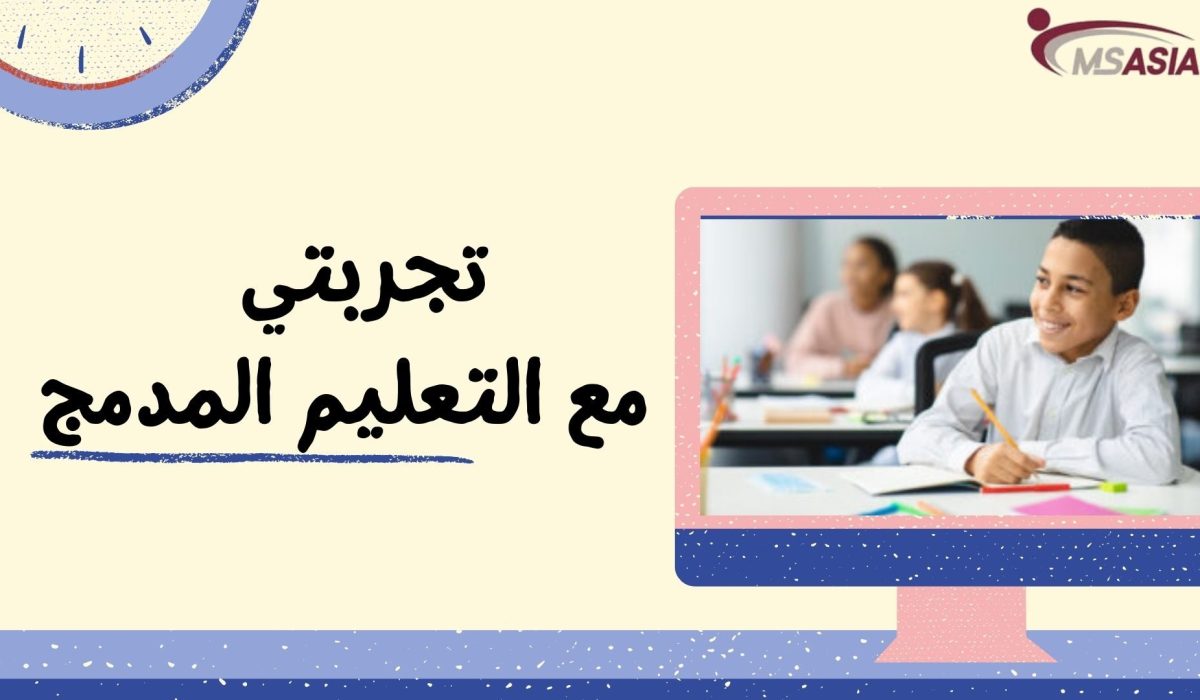
First day:
I stood in front of the computer screen, wondering, “How will I combine the traditional chapter with these electronic platforms?”
But the decision was taken… I joined the integrated education programme.
First week:
-
In class, we laughed with the professor about a joke about the difficulty of mathematics.
-
On the online platform, I found videos explaining the lesson slowly, as if it was assigned to me alone!
Third month:
I started touching the change…
-
I get up early to open the recorded lectures while drinking my coffee.
-
On campus, my colleagues and I are discussing what we can’t understand on the platform.
Challenges I faced:
One night… the internet was cut off an hour before the assignment!
I cried, “Why now?!”… Then I remembered that I could go to college to complete it.
Another day…
I found myself scattered between the noise of the house and the quiet of the classroom…
But I learned to make a bright corner in my room to study.
Gains I didn’t expect:
-
I found out that I can Learn programming Through interactive videos… without waiting for the professor’s explanation.
-
In a class discussion, I presented an idea that I had a comment I read on the online forum… Everyone was surprised!
End of the semester:
I sat down to review my electronic and paper notes together…
She smiled, “I have survived the challenges… and I am getting faster, and more disciplined.”
One last word:
If I go back in time…
I would choose blended education again, but with more confidence.
Because he taught me that the walls aren’t boundaries… in the classroom may be between four walls, or behind a bright screen.
Blended Education in Contexts
In schools (K-12): Integrating interactive activities in the classroom with short virtual lessons through attractive platforms.
In universities: Integrating online lectures with practical experiences in laboratories or workshops.
In institutional training: the use of short electronic courses with virtual or realistic application sessions to develop the skills of employees.
Ethical and legal considerations:
-
Tighten the procedures for protecting the users’ data and educating them about the privacy of the information.
-
Implementation of strict systems to detect plagiarism and respect for intellectual property rights.
-
Providing free hardware and internet for low-income students to ensure equal opportunities.
The most important sources
-
https://journals.ekb.eg/Article_173144.html
-
https://qspace.qu.edu.qa/handle/10576/22327
-
https://journals.ekb.eg/Article_342589.html
-
https://en.wikipedia.org/wiki/blended_learning
-
https://mahdyideas.com/2025/01/02/%D8%A7%D9%8 4%D8%B0%D8%A7%D8%A1-%D8%A7%D8%D8%A7%D 8%B5%D8%B7%D{6%D8%A7%D8%B9%D{A-%D}1%D9% 8A-D8%A7%D8%AA%D8%B9%D84%D8%A%D{5/
